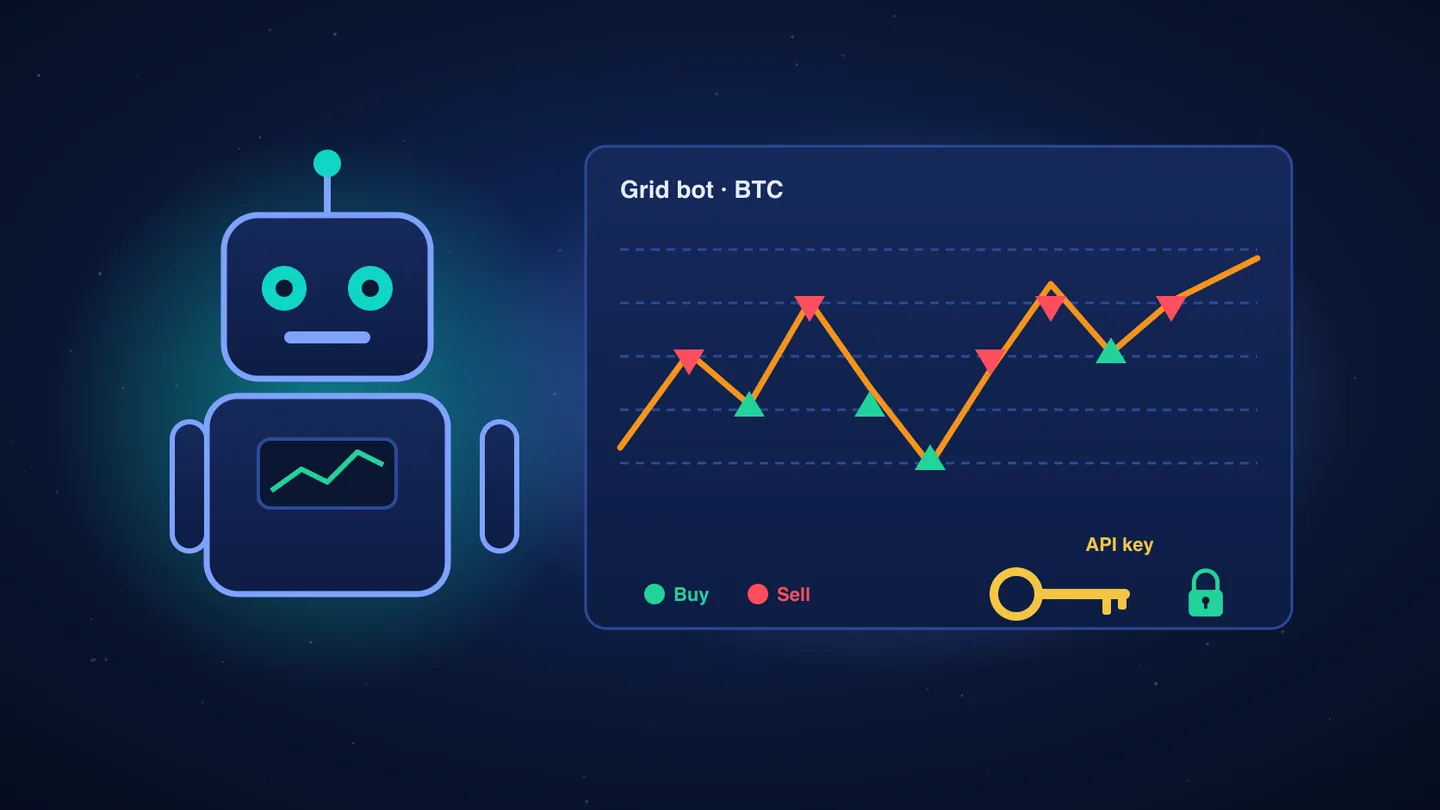
Crypto markets never close. Bitcoin trades at 3 a.m. on a Sunday as easily as on a Tuesday afternoon, and no human can watch the screen all the time. That is the promise of a trading bot: software that buys and sells for you, by rules you set, around the clock.
But most bots don’t predict anything. They simply follow instructions, very fast and without emotion, and that can help you or hurt you depending on the market.
This guide explains how trading bots work and the main types. We also tested two popular bots on real Bitcoin prices, and cover where to get one, how to stay safe, and how advanced traders build and test their own.
How a trading bot works
Every bot has three parts:
- A strategy: the rules. For example: “buy $100 of Bitcoin every Monday”, or “buy every time the price drops 1%, sell every time it rises 1%”.
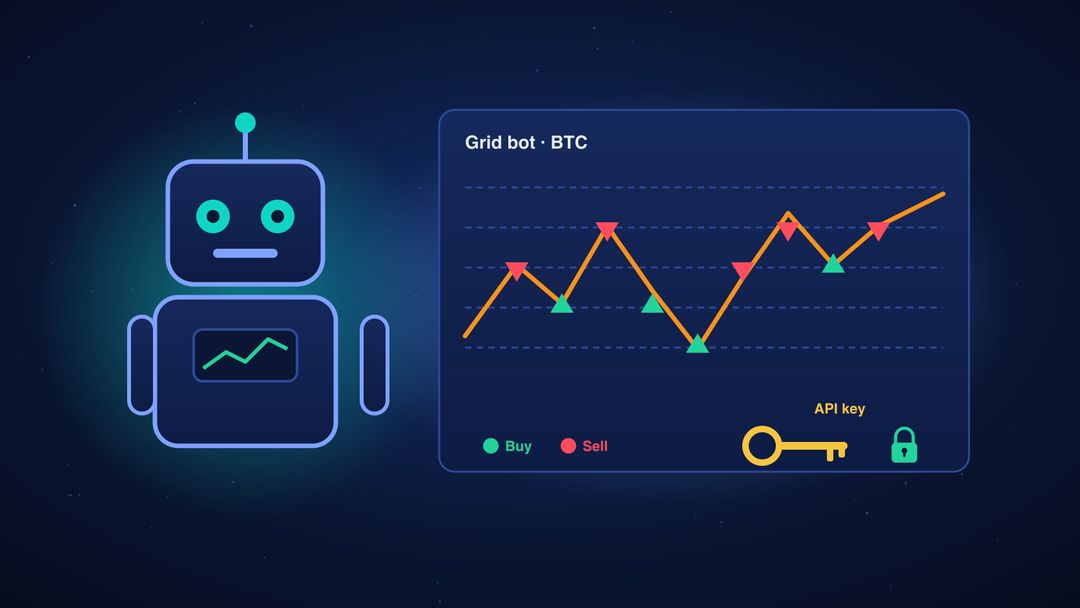
- A connection to your exchange: usually an API key, a password-like code that lets the bot place orders in your account without knowing your login.
- Execution: the bot checks prices and places orders automatically, 24/7.
Bots run in four kinds of places:
- Built into the exchange. Binance, Bybit, OKX, KuCoin and others offer ready-made grid and DCA bots inside their apps. Easiest to start with, and no API key to hand out.
- Third-party platforms such as 3Commas, Cryptohopper or Coinrule. They connect to several exchanges through API keys and offer more strategies and tools, usually for a monthly fee.
- Open-source software such as Freqtrade or Hummingbot. Free, fully customizable and run on your own computer or server, but you need some technical skill.
- Alerts and webhooks. Traders write signals on charting sites like TradingView and send them to a bot that places the orders.
The main types of bots
DCA bots
The simplest and most popular. A DCA (dollar-cost averaging) bot buys a fixed amount at regular intervals, whatever the price. Many exchanges call it “recurring buy”. It doesn’t try to time the market; it spreads your entries over time.
Grid bots
A grid bot splits a price range into levels, like the rungs of a ladder. It places buy orders below the current price and sell orders above it. Every time the price drops one rung, it buys; every time it rises one rung, it sells. In a market that moves up and down, it collects a small profit on every swing.
Signal and trend bots
These follow indicators, such as “buy when the 50-day average crosses above the 200-day average”, or signals from a paid service. They try to ride trends and step aside in downtrends.
Rebalancing bots
You set a target, such as 60% Bitcoin and 40% stablecoins. When prices move the mix away from the target, the bot sells some of what went up and buys some of what went down.
Arbitrage bots
They look for the same coin priced differently on two exchanges, or between spot and futures, and trade both sides. The gaps are tiny and competition is fierce, so this is mostly a game for professionals with fast connections.
Market-making bots
They place buy and sell orders on both sides of the order book and earn the difference (the spread). This is what professional market makers do. Hummingbot is built for it.
Copy trading
Not a bot in the strict sense: you choose a trader on the exchange and automatically copy their trades. Simple, but past results can be misleading, and many copied traders use high leverage.
Telegram and on-chain bots
On decentralized exchanges, Telegram bots let you buy new tokens in seconds, often seconds after launch. Convenient, but many of them hold your wallet’s private key, and some have been hacked.
We tested two bots on real Bitcoin prices
We simulated two of the most popular bots on real BTC-USD prices from Coinbase, including a 0.1% trading fee on every order.
Test 1: a weekly DCA bot
$100 of Bitcoin every Monday, from January 6, 2025 to November 2, 2026: 96 purchases, $9,600 invested in total.
| Invested | Value on Nov 2, 2026 | Result | |
|---|---|---|---|
| DCA bot ($100 a week) | $9,600 | $8,584 | −10.6% |
| Everything on day one | $9,600 | $7,206 | −29.6% |
Bitcoin was about $102,300 when the test started and $76,800 at the end. The DCA bot’s average buying price was $85,853, so it lost much less than buying everything at once. DCA doesn’t guarantee a profit, but it protects you from putting all your money in at the worst moment.
Test 2: a grid bot in three different markets
A grid bot with 20 levels and $10,000, in three periods of 2026:
| Market | Period | Grid range | Grid bot | Just holding Bitcoin |
|---|---|---|---|---|
| Sideways | Sep 1 – Nov 2 | $74,000–$88,000 | +2.4% | −2.3% |
| Crash | May 6 – Jul 1 | $72,000–$84,000 | −21.2% | −25.9% |
| Rally | Jul 1 – Aug 31 | $56,000–$68,000 | +9.0% | +34.2% |
What happened:
- Sideways: this is where grid bots shine. Bitcoin bounced between $75,000 and $87,000, the bot traded more than 200 times, and it made money while Bitcoin itself lost a little.
- Crash: Bitcoin fell from about $81,000 to $60,000, far below the grid. The bot kept buying all the way down and ended up holding only Bitcoin, with no cash left. It lost almost as much as simply holding. A grid bot is not a stop-loss.
- Rally: Bitcoin shot from $58,500 to $78,500, above the top of the grid. The bot sold its coins rung by rung on the way up, and once the price left the range it held only cash. It made 9%, but missed most of a 34% rally.
The lesson: a grid bot is a bet that the price stays in a range. It earns in sideways markets, and either misses rallies or holds the bag in crashes.
Where to get a bot
- Start with your exchange’s built-in bots. No API key to share, simple settings, and you can try small amounts. Most also offer a demo or paper-trading mode.
- Third-party platforms make sense when you trade on several exchanges or want more advanced strategies. Check their security record and pricing carefully.
- Open-source bots (Freqtrade, Hummingbot) are for people who are comfortable with code and want full control and no subscription.
The risks nobody mentions
Your API key is the key to your account
If a bot platform is hacked, attackers can trade in your account. In December 2022, the bot platform 3Commas confirmed that users’ API keys had leaked. Attackers used them to make losing trades on victims’ accounts, and some users lost millions. Always:
- Never enable withdrawals on an API key used by a bot. Allow trading only.
- Restrict the key to the bot’s IP address if the exchange allows it.
- Use a separate sub-account with only the money the bot needs.
- Delete keys you no longer use.
“Guaranteed profit” bots are scams
Any bot that promises fixed daily returns, “AI that never loses”, or asks you to send money to a wallet so it can “trade for you” is almost certainly a scam. A real bot runs on your exchange account, and you can turn it off at any time.
A bot can’t see a crash coming
Bots follow their rules even when the world changes: a hack, a Fed surprise, an exchange collapse. Combined with leverage, a bot can wipe out an account in minutes. Some bot types, such as martingale bots that double their position after every loss, are especially dangerous.
Fees eat small profits
Bots trade often. With 0.1% fees on each side, a grid step smaller than about 0.2% loses money on every round trip. Check the fees before you set the grid.
Advanced: building and testing your own strategy
- Backtest, but honestly. Include fees and slippage, and avoid look-ahead bias: never use information the bot couldn’t have had at that moment. In our SMT divergence test, a signal that looked great in hindsight turned out to be a coin flip once we removed that bias.
- Keep data aside. Build the strategy on one period and test it on another it has never seen (out-of-sample, or walk-forward testing). If it only works on the data it was tuned on, it is overfitted.
- Check parameter sensitivity. If a strategy works with a 20-day average but fails with 18 or 22 days, it is fragile.
- Know which market you are in. Grid and mean-reversion bots like ranges; trend bots like trends. Many traders switch bots off when the regime changes. Signs of a crowded, nervous market show up on our Leverage & Liquidations dashboard.
- Do the grid math. Profit per round trip ≈ grid step − 2 × fee. Arithmetic grids use equal dollar steps; geometric grids use equal percentage steps, which suits wide ranges better.
- Build in a kill switch. A maximum loss per day, a maximum position size, and alerts when something breaks. Then watch it: a bot that runs unattended is a bot that can fail unnoticed.
Checklist before you start a bot
- Choose a strategy that fits the current market, and know when it fails.
- Start with the exchange’s built-in bot and a small amount.
- If you use an API key: trading only, no withdrawals, IP-restricted, in a sub-account.
- Check fees against the size of each trade.
- Avoid leverage until you fully understand how the bot behaves in a crash.
- Set a point at which you stop the bot, and stick to it.
The takeaway
Trading bots are tools, not money machines. A DCA bot is a simple, disciplined way to invest over time. A grid bot can earn steady small profits in a sideways market. But no bot knows what comes next: in a crash or a strong rally, a bot does exactly what you told it to do, even when that is the wrong thing.
This article is for information only and is not financial advice. Simulations use BTC-USD prices from Coinbase, a 0.1% fee per order, and do not guarantee future results.
Frequently asked questions
What is a crypto trading bot?
A trading bot is software that buys and sells for you, by rules you set, around the clock. Most bots don't predict anything; they follow instructions quickly and without emotion.
Do crypto trading bots make money?
It depends on the market. In our tests a grid bot earned in a sideways market, but it missed most of a rally and lost heavily in a crash. No bot knows what comes next.
What is a grid bot?
A grid bot places buy orders below the price and sell orders above it, like rungs on a ladder. It is a bet that the price stays in a range.
What is a DCA bot?
A DCA bot buys a fixed amount at regular intervals, whatever the price. Many exchanges call it recurring buy. It spreads your entries over time and does not guarantee a profit.
Are trading bots safe?
Only with care. Never enable withdrawals on a bot's API key, restrict the key to the bot's IP address, use a separate sub-account, and delete keys you no longer use.
Are guaranteed-profit bots a scam?
Almost certainly. Be wary of fixed daily returns, AI that never loses, or requests to send money to a wallet. A real bot runs on your exchange account, and you can turn it off.
Where should a beginner get a trading bot?
Start with your exchange's built-in bots. There is no API key to share, settings are simple, and you can try small amounts. Most also offer a demo or paper-trading mode.