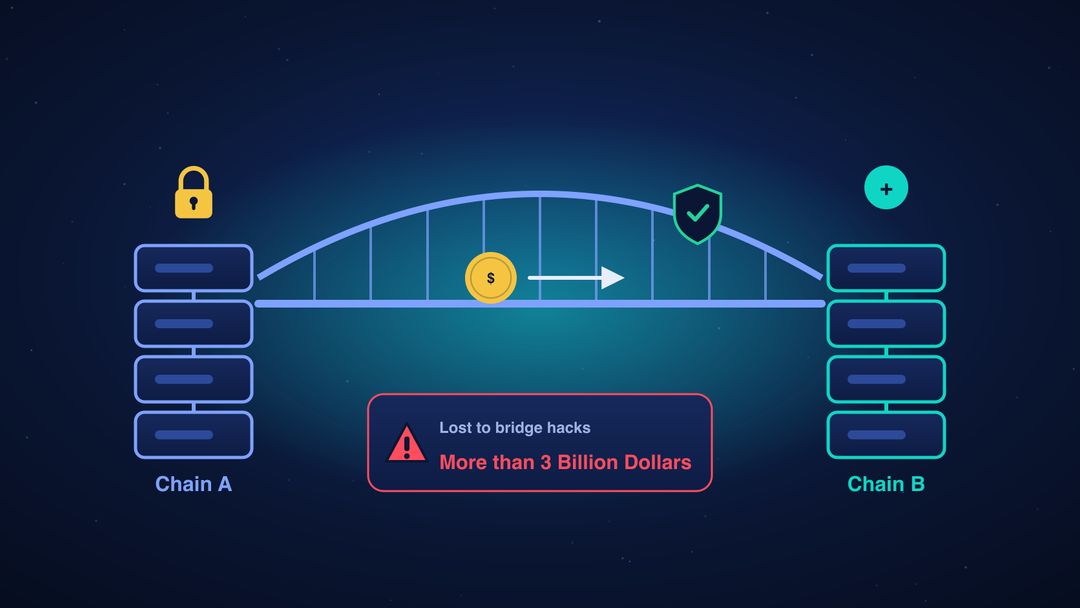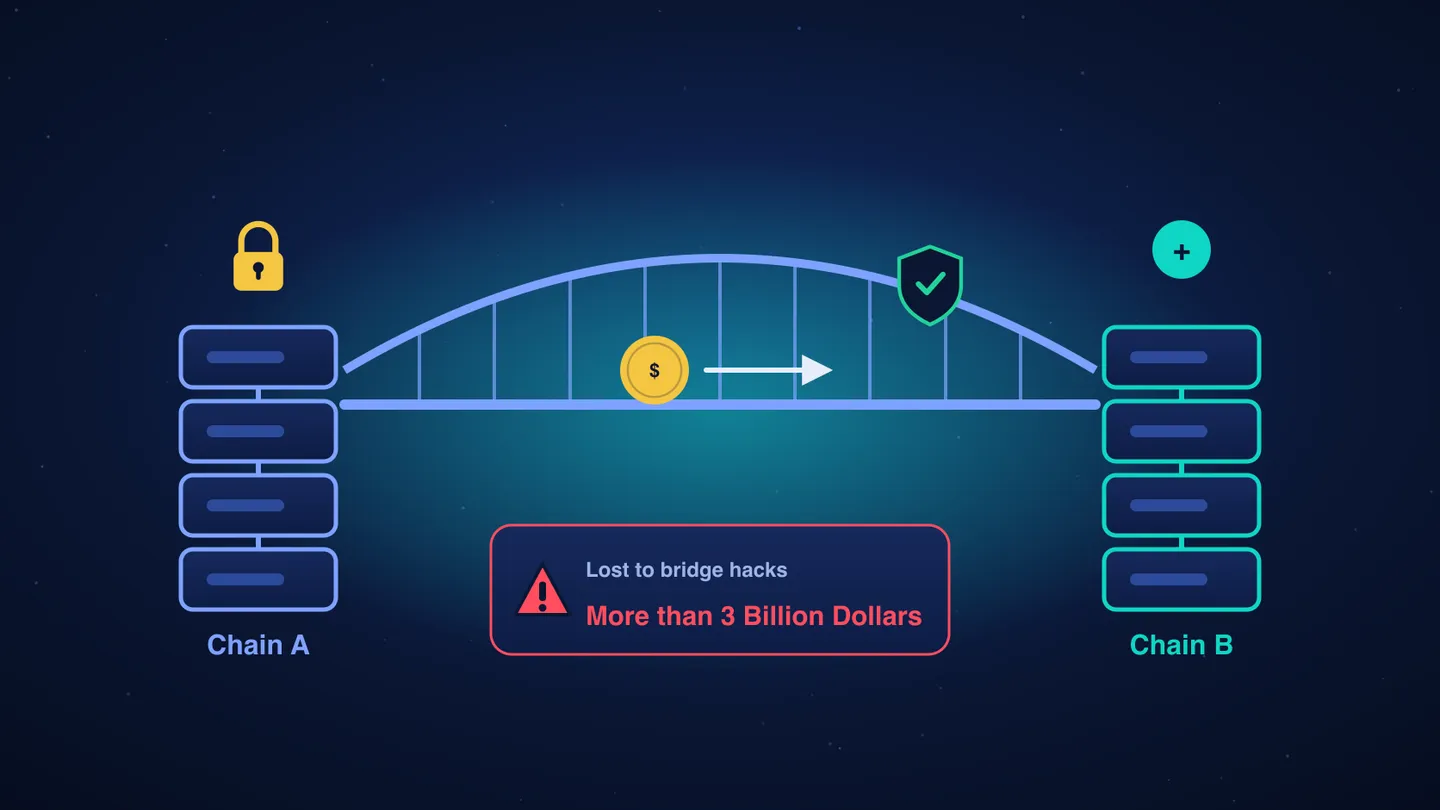
There are hundreds of blockchains, and they can’t talk to each other. Your ETH on Ethereum can’t simply walk over to Solana, and your USDC on Base doesn’t exist on Arbitrum. To move value between them, you need a bridge.
Bridges carry billions of dollars every month. They are also one of the riskiest places in crypto: the nine hacks in this guide took about $3.1 billion between them, and two of them happened in 2026.
This guide explains how bridges work, what goes wrong, and how to use them safely.
Why bridges exist
Each blockchain keeps its own record of who owns what. Ethereum doesn’t know what happens on Solana, and Solana can’t read Ethereum. A token is really just an entry in one chain’s records, so it can’t physically “move” to another chain.
A bridge solves this with a trick: it takes your tokens out of circulation on chain A and gives you an equal amount on chain B. Done right, the total stays the same. Done wrong, someone ends up with tokens on chain B that nothing backs on chain A.
The five types of bridges
1. Lock and mint (wrapped tokens)
The oldest design. You send your tokens to the bridge, which locks them on chain A and mints the same amount of a wrapped version on chain B. To go back, the wrapped tokens are burned and the originals unlocked.
- Pro: works for almost any token.
- Con: the bridge holds a giant pile of locked tokens. If it is hacked, the wrapped tokens on the other side become worthless IOUs.
2. Burn and mint (native tokens)
When the token’s issuer controls it on every chain, there is no need for wrapping. Circle’s CCTP (Cross-Chain Transfer Protocol), for example, burns your USDC on the source chain and mints real USDC on the destination.
- Pro: you get the real token, not a copy, and nothing sits locked in a pool.
- Con: only possible for tokens whose issuer supports it.
3. Liquidity networks
These bridges keep pools of the same token on both chains. You deposit on chain A, and you are paid out from the pool on chain B. No wrapped token is created.
- Pro: fast, and you receive the native asset.
- Con: limited by pool size, and the pools themselves are a target.
4. Intent-based bridges
The newest design. You state what you want (“I send 1 ETH on Arbitrum, I want 1 ETH on Base”), and independent solvers (also called relayers or fillers) compete to pay you on the destination chain within seconds, from their own money. The bridge reimburses them later.
- Pro: very fast and often the cheapest option.
- Con: you depend on solvers’ infrastructure, which can itself be attacked.
5. Native (canonical) bridges
Every layer-2 network, such as Arbitrum, Optimism or Base, has an official bridge to Ethereum, built into the network itself.
- Pro: usually the most secure option, backed by the rollup’s own security.
- Con: slow in one direction. Withdrawing from an optimistic rollup back to Ethereum takes about 7 days, the time allowed for anyone to challenge a fraudulent withdrawal.
Who decides that a transfer is real?
Every bridge has to answer one question: how does chain B know that something really happened on chain A? The answer decides how safe the bridge is.
- A group of validators or a multisig: a set of people or companies sign off on each transfer. Simple, but if enough of their keys are stolen, the attacker can approve anything.
- Oracles and relayers: independent parties pass and confirm messages. Messaging protocols such as LayerZero, Wormhole and Chainlink CCIP let each app choose who verifies its messages and how many must agree.
- Light clients and zero-knowledge proofs: chain B checks chain A’s own cryptographic proofs, without trusting a middleman. The most secure approach, but harder to build.
- Optimistic verification: transfers are assumed valid unless someone proves fraud within a challenge window. Secure as long as at least one honest watcher is paying attention.
A simple rule: the fewer people you have to trust, the safer the bridge.
Nine of the biggest bridge hacks
| Bridge | Date | Stolen | What went wrong |
|---|---|---|---|
| Ronin | March 2022 | $620M | Attackers stole 5 of the 9 validator keys |
| Poly Network | August 2021 | $610M | Access-control flaw (the hacker returned almost all of it) |
| BNB Bridge | October 2022 | $570M | Fake proof let the attacker create 2 million BNB; about $100–130M left the chain |
| Wormhole | February 2022 | $320M | Signature check bug on Solana; Jump Crypto refilled the funds |
| Liquid Network | September 2026 | $320M | Software bug created about 4,000 unbacked L-BTC; most was returned |
| Kelp (rsETH) | April 2026 | $292M | Fake cross-chain message; LayerZero says Kelp used a single verifier |
| Nomad | August 2022 | $190M | An upgrade made every message look valid; hundreds copied the attack |
| Multichain | July 2023 | $126M | Team said only its CEO held the server keys; who moved the funds is still unknown |
| Harmony | June 2022 | $100M | Attackers needed only two multisig signatures |
Amounts are approximate, in US dollars at the time, from project statements and press reports.
Almost every bridge hack falls into one of three groups:
- Stolen or misused keys. If a bridge is run by a handful of signers, a few keys are enough (Ronin, Harmony, and possibly Multichain).
- Verification bugs. The bridge accepts a fake message or proof and releases funds that were never deposited (Wormhole, BNB Bridge, Nomad).
- Weak settings. The bridge technology may be sound, but the app using it chooses a risky setup.
Two lessons from 2026
- Kelp, April 2026. Attackers fed a fake cross-chain message into Kelp’s rsETH bridge and drained about $292 million. LayerZero says Kelp used a single verifier despite advice to add more, so one compromised point was enough. It also linked the attack, as a preliminary finding, to North Korea’s Lazarus Group. Lesson: the security of a messaging protocol depends on how each app configures it.
- Liquid Network, September 2026. A bug in Elements, the software behind Bitcoin’s Liquid sidechain, let an attacker create about 4,000 L-BTC with no Bitcoin behind it. The fake L-BTC was swapped out through a legitimate exit service, and the Liquid Federation released about 3,996 real BTC (about $320 million). The federation said its keys were never compromised. The attacker sent back about 3,400 BTC the next day, and the federation announced full 1:1 backing again on November 3, after new deposits reported to come from Blockstream. Lesson: even with safe keys, a single software bug can break the peg.
You can follow every hack, including bridges, on our Crypto Hacks dashboard.
The risks for ordinary users
Even when the bridge itself is not hacked, users can lose money:
- Wrapped tokens can lose their peg. When Multichain collapsed in 2023, many “Multichain” tokens on other chains became nearly worthless overnight.
- Fake bridge websites. Scammers copy popular bridges and advertise them in search results and on social media. Connect your wallet to the wrong site and your funds are gone.
- Wrong network or wrong token. Sending to the wrong chain, or receiving a wrapped token you didn’t expect, is a common and sometimes permanent mistake.
- Unlimited approvals. Bridges ask permission to move your tokens. If that permission is unlimited and the bridge is later exploited, your wallet can be drained.
- Delays and stuck transfers. Busy networks, the 7-day rollup exit or a paused bridge can leave your money in limbo.
How to bridge safely: a checklist
- Use the official or best-known route. The network’s own bridge, Circle’s CCTP for USDC, or a bridge with a long, clean track record.
- Get the link from the official source, such as the project’s documentation, never from an ad or a direct message. Bookmark it.
- Send a small test amount first, and wait until it arrives.
- Check what you will receive: the native token, or a wrapped version? Check the contract address on the destination chain.
- Compare routes with an aggregator such as Jumper or Bungee, which compare many bridges for price and speed, but still check which bridge they pick for you.
- Approve only the amount you are bridging, and revoke old approvals from time to time.
- Don’t leave funds in wrapped tokens longer than you need. The longer you hold, the longer you carry the bridge’s risk.
- Or skip the bridge entirely: many exchanges let you deposit on one network and withdraw on another. It is often simpler and cheaper, at the cost of trusting the exchange for a few minutes.
Advanced: where bridges are heading
- From custody to messaging. Instead of giant lockboxes, bridges increasingly pass messages between chains and let issuers burn and mint tokens natively. Less money sits in one place.
- Configurable security. Messaging protocols let each app pick its own verifiers and how many must agree (LayerZero calls these Decentralized Verifier Networks). The Kelp hack shows that the defaults matter as much as the technology.
- Rate limits and circuit breakers. Modern bridges cap how much can leave in a given time, so a bug drains millions instead of hundreds of millions.
- Intents and chain abstraction. Users increasingly won’t see bridges at all: a wallet or app takes your request and handles the cross-chain part behind the scenes. Convenient, but the risks don’t disappear; they just move out of sight.
- Zero-knowledge proofs. Proof-based bridges remove trusted middlemen. As the technology gets cheaper, expect more bridges to verify chains mathematically instead of by signatures.
The takeaway
Bridges are the roads between blockchains: essential, busy and a favorite target for thieves. The safest bridge is the one that asks you to trust the fewest people, holds the least money, and has been tested the longest. Use official routes, test with small amounts, and don’t leave more money in wrapped tokens, or for longer, than you need to.
This article is for information only and is not financial advice. Hack amounts are approximate and come from project statements and press reports, as of November 2026.
Frequently asked questions
What is a crypto bridge?
A bridge moves value between blockchains. It takes your tokens out of circulation on chain A and gives you an equal amount on chain B, because tokens cannot physically move between chains.
Are crypto bridges safe?
They carry real risk. The nine hacks in this guide alone cost about $3.1 billion. The safest bridges ask you to trust the fewest people and have been tested the longest.
Why do bridges get hacked?
Almost every bridge hack falls into three groups: stolen keys, verification bugs that accept fake messages or proofs, and weak settings chosen by the app using the bridge.
What is the safest way to bridge crypto?
Use the network's official bridge or a well-known route, get the link from official documentation, send a small test first, and approve only the amount you are bridging.
Why does withdrawing from a layer-2 take 7 days?
Withdrawing from an optimistic rollup back to Ethereum through its native bridge takes about 7 days. That is the time allowed for anyone to challenge a fraudulent withdrawal.
Can I move crypto between chains without a bridge?
Yes. Many exchanges let you deposit on one network and withdraw on another. It is often simpler and cheaper, at the cost of trusting the exchange for a few minutes.