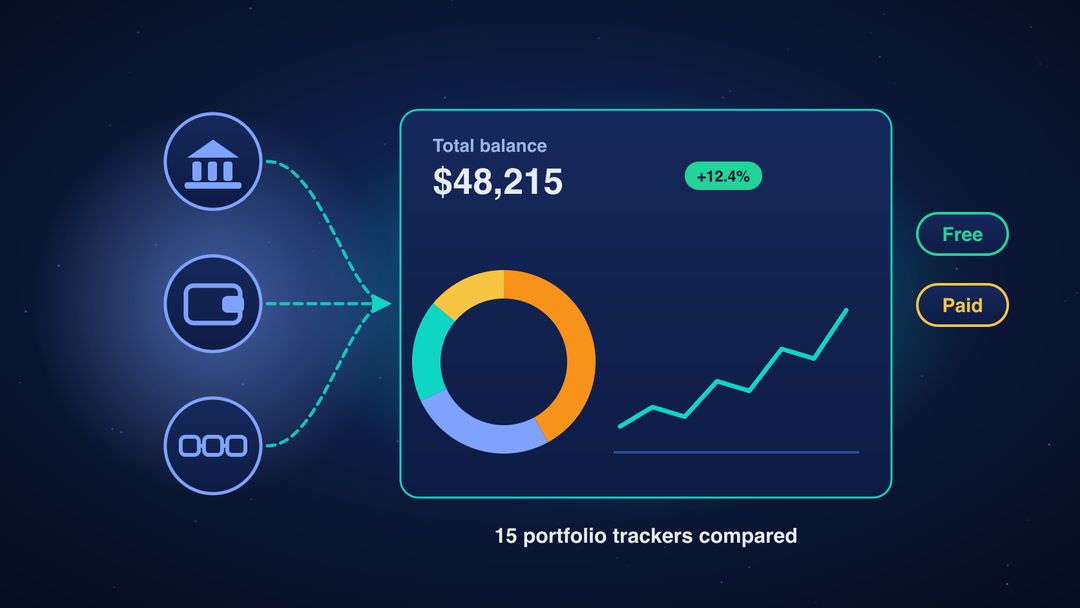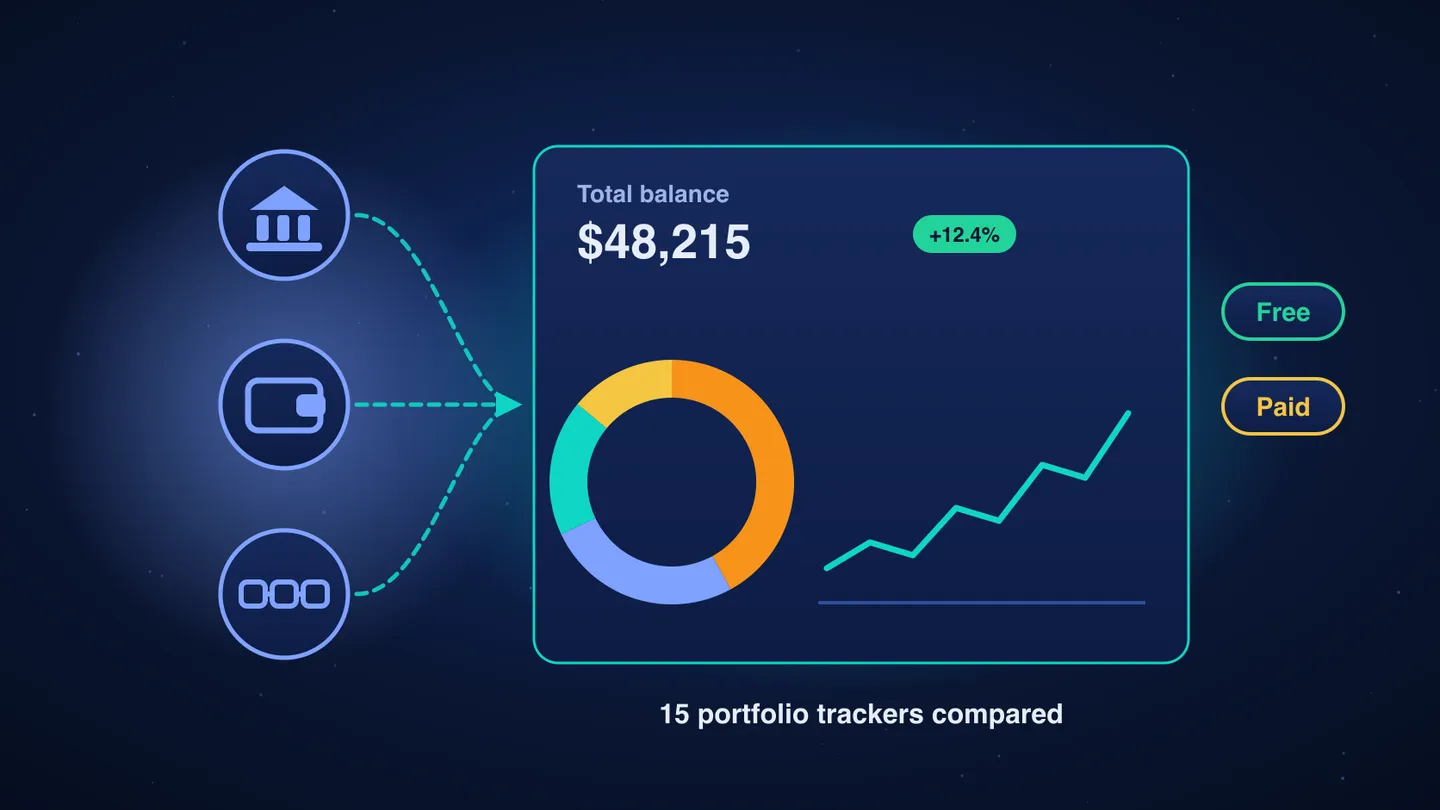
If your crypto sits on two exchanges, a hardware wallet and a couple of DeFi apps, you probably don’t know your real balance, your real profit, or what you would owe in taxes. A portfolio tracker puts everything in one place: it reads your exchange accounts and wallet addresses and shows your holdings, performance and history on a single screen.
We picked 15 trackers that are still active in 2026, grouped by how you would use them.
Before you start: a tracker only needs to read your data. Connect exchanges with read-only API keys (no trading, no withdrawals), add wallets by their public address, and never type your recovery phrase into any tracker.
Free trackers
1. CoinGecko Portfolio
The simplest place to start. You add coins and transactions by hand, and CoinGecko tracks their value with its own price data for thousands of coins. No accounts to connect, no keys to share.
- Best for: beginners and long-term holders with a few coins
- Price: free (an optional Premium plan removes ads)
- Watch out: mostly manual entry, so it is slow if you trade often
2. CoinMarketCap Portfolio
CoinMarketCap’s free tracker goes one step further: besides manual entries, it can follow public wallet addresses and connect exchange accounts so balances update by themselves.
- Best for: a free tracker that updates automatically
- Price: free
- Watch out: basic profit and loss; no tax reports
3. DeBank
DeBank is the go-to tracker for Ethereum and EVM chains. Paste any wallet address and it shows tokens, NFTs and positions inside DeFi protocols (lending, liquidity pools, staking) across dozens of networks.
- Best for: DeFi users on Ethereum, Base, Arbitrum and other EVM chains
- Price: free to track
- Watch out: no Bitcoin or Solana, and no exchange accounts
4. Jupiter Portfolio
The Solana counterpart to DeBank. Built by the Jupiter exchange, it shows token balances, DeFi positions, staking and history across 180+ Solana protocols for any public address, without connecting a wallet.
- Best for: Solana users
- Price: free
- Watch out: Solana only
5. rotki
rotki is open source and runs on your own computer, so your financial data never sits on someone else’s server. It tracks wallets, exchanges and DeFi, and calculates profit and loss.
- Best for: privacy-minded and technical users
- Price: the base version is free forever; a paid Premium subscription adds more features and higher limits
- Watch out: a steeper learning curve than an app
Free with paid upgrades
6. CoinStats
One of the most popular all-in-one apps: it connects hundreds of exchanges and wallets, tracks DeFi and NFTs, and works on phone and web.
- Best for: active investors who want everything in one app
- Price: free plan with limits on portfolios and transactions; Premium costs about $14 a month billed yearly
- Watch out: the best features are behind the paid plan
7. Delta (by eToro)
Delta tracks crypto and stocks, ETFs and funds in one clean app, which makes it a good fit if crypto is only part of your investments.
- Best for: people who hold both crypto and traditional investments
- Price: free app; a paid Pro plan adds more connections and analytics
- Watch out: lighter on DeFi than crypto-native trackers
8. Zerion
Zerion is a self-custody wallet and a portfolio tracker in one. It covers dozens of chains, including Ethereum, Solana and Base, and thousands of DeFi protocols, on mobile, web and as a browser extension.
- Best for: DeFi users who want to track and act from the same app
- Price: free; Zerion Premium adds full EVM and Solana history and more detailed profit and loss
- Watch out: focused on on-chain wallets, not exchange accounts
9. Nansen
Nansen is best known for on-chain analytics, such as following “smart money” wallets, but it also offers a portfolio view across many chains, next to its research tools.
- Best for: investors who also want deep on-chain research
- Price: free plan with basic portfolio tracking; Pro costs $49 a month billed yearly ($69 monthly)
- Watch out: expensive if you only need a tracker
Trackers with tax reports
These tools are built to calculate your gains for the tax office. Most let you track your portfolio for free and charge only when you download a tax report.
10. Koinly
Koinly supports hundreds of exchanges and wallets and produces tax reports for many countries.
- Best for: a reliable tracker that also handles taxes
- Price: free portfolio tracking; tax reports are bought per tax year, starting around $49
- Watch out: the price grows with your number of transactions
11. CoinTracker
CoinTracker, one of the best-known names in the US, connects exchanges and wallets automatically and builds tax forms from your history.
- Best for: US investors who want tax forms done for them
- Price: a small free plan; paid plans depend on your number of transactions
- Watch out: the free plan covers only a handful of transactions
12. CoinLedger
CoinLedger focuses on taxes but lets you track your full transaction history and gains for free.
- Best for: occasional investors who need one tax report a year
- Price: free portfolio tracking with no transaction limit; each tax report is a one-time purchase from $49 (up to 100 transactions) to $199+ (3,000+)
- Watch out: no ongoing subscription, but you pay again every tax year
13. Blockpit
Blockpit is a European tax and tracking tool with country versions across most of the EU, the UK and beyond.
- Best for: European investors
- Price: free portfolio tracking; Blockpit Plus €59 a year; tax reports from €49 per tax year
- Watch out: the biggest advantage is in European tax rules
14. CoinTracking
CoinTracking is a veteran tool with very detailed reports, charts and tax calculations, loved by heavy traders.
- Best for: active traders with thousands of transactions
- Price: free plan to view your portfolio (no new imports); paid plans from $49 a year (200 transactions) to $899 a year (unlimited)
- Watch out: a busy interface with a lot to learn
Paid net-worth tracker
15. Kubera
Kubera is not just for crypto: it tracks your whole net worth, including bank accounts, stocks, real estate, cars and crypto wallets and exchanges, in one clean balance sheet. It also lets you set up who inherits access to your data.
- Best for: people who want crypto next to everything else they own
- Price: about $250 a year
- Watch out: no free plan, and less detail on DeFi
Quick comparison
| Tracker | Free plan | Paid from | Best for |
|---|---|---|---|
| CoinGecko | Yes | Optional | Beginners |
| CoinMarketCap | Yes | No | Free auto-sync |
| DeBank | Yes | No | EVM DeFi |
| Jupiter Portfolio | Yes | No | Solana |
| rotki | Yes | Premium | Privacy |
| CoinStats | Yes | ~$14/month (yearly) | All-in-one app |
| Delta | Yes | Pro | Crypto + stocks |
| Zerion | Yes | Premium | DeFi wallet + tracker |
| Nansen | Yes | $49/month (yearly) | On-chain research |
| Koinly | Tracking | ~$49/tax year | Tracking + taxes |
| CoinTracker | Small | Varies | US tax forms |
| CoinLedger | Tracking | $49/report | One report a year |
| Blockpit | Tracking | €49/tax year | Europe |
| CoinTracking | View only | $49/year | Heavy traders |
| Kubera | No | ~$250/year | Total net worth |
How to choose
- Just a few coins? Start with CoinGecko or CoinMarketCap.
- Mostly in DeFi? DeBank for EVM chains, Jupiter for Solana, or Zerion for both.
- Crypto and stocks? Delta, or Kubera for your whole net worth.
- Need a tax report? Koinly, CoinLedger or CoinTracker, or Blockpit in Europe.
- Care most about privacy? rotki.
One more thing: in August 2026 the popular tracker Zapper shut down after seven years. Trackers come and go, so export your transaction history from time to time and keep a copy.
Prices and features change often. Check each provider’s website before you subscribe. This article is for information only and is not financial or tax advice.
Frequently asked questions
What is a crypto portfolio tracker?
A portfolio tracker reads your exchange accounts and wallet addresses and shows your holdings, performance and history on one screen. It only needs to read your data, not move it.
What is the best free crypto portfolio tracker?
It depends on what you hold. CoinGecko or CoinMarketCap suit a few coins, DeBank suits EVM DeFi, Jupiter suits Solana, and rotki suits people who care most about privacy.
Are crypto portfolio trackers safe?
They can be, if you limit what they see. Connect exchanges with read-only API keys, add wallets by public address, and never type your recovery phrase into any tracker.
Which crypto tracker does taxes?
Koinly, CoinLedger and CoinTracker are the main options, and Blockpit suits Europe. Most let you track for free and charge only when you download a tax report.
Which tracker covers both crypto and stocks?
Delta tracks crypto, stocks, ETFs and funds in one app. Kubera goes further and tracks your whole net worth, including bank accounts and real estate, but it has no free plan.