Options are one of the oldest tools in finance, and today one of the fastest-growing corners of crypto. On November 2, 2026, traders on Deribit alone held Bitcoin options worth about $23.7 billion, and options on BlackRock’s Bitcoin ETF (IBIT) are now just as big.
This guide starts from zero and goes all the way to the indicators professional traders watch. If you are new, read the first part and stop whenever you like. If you already trade, skip to the advanced section.
All examples use real Bitcoin option prices from Deribit on November 2, 2026, when Bitcoin traded at about $78,000.
Part 1: The basics
What is an option?
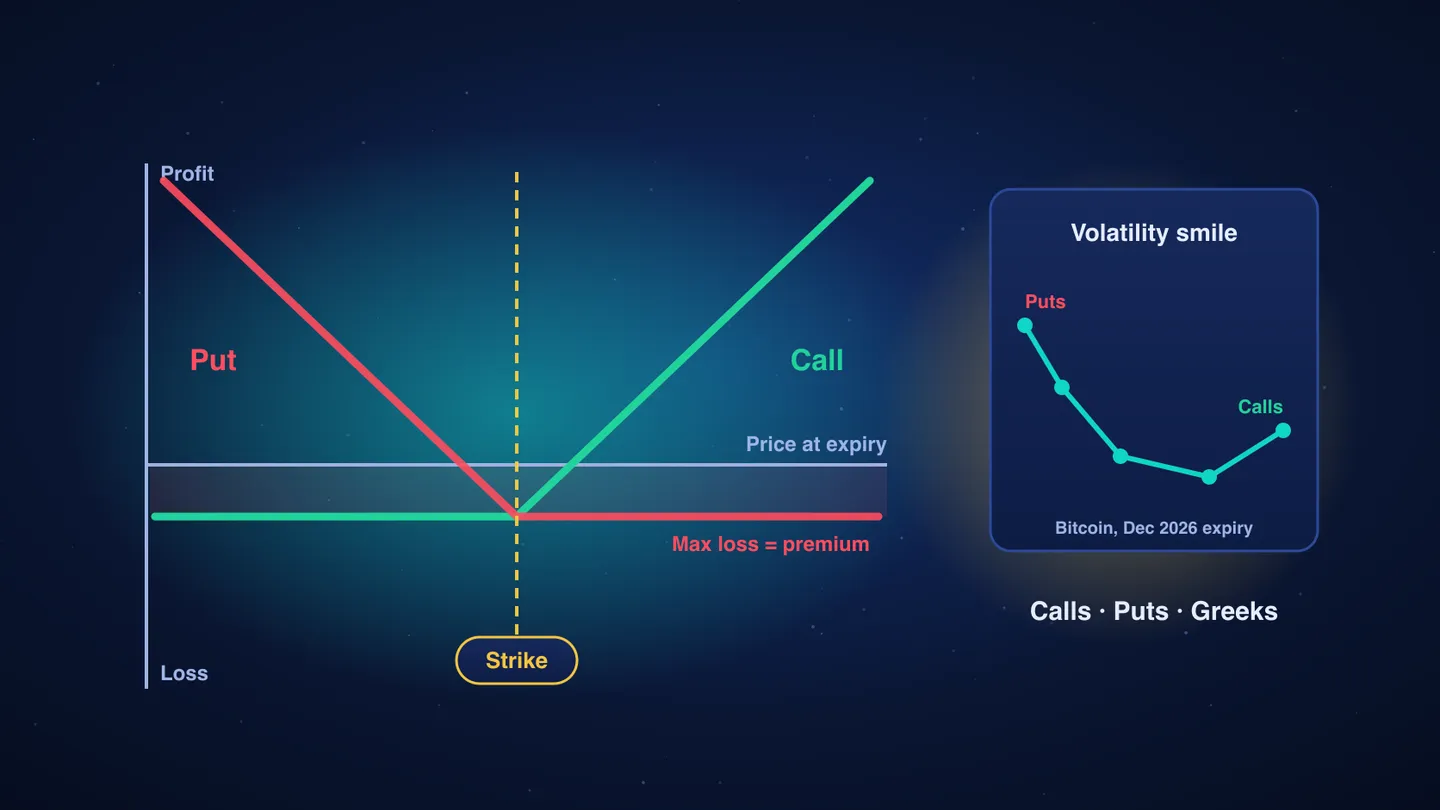
An option is a contract that gives you the right, but not the obligation, to buy or sell something at a fixed price before or on a fixed date. You pay a small amount upfront for that right.
A simple comparison is a deposit on a house. You pay $5,000 to lock in a price of $300,000 for three months. If house prices rise, you buy at $300,000 and win. If they fall, you walk away and lose only the $5,000.
There are only two types:
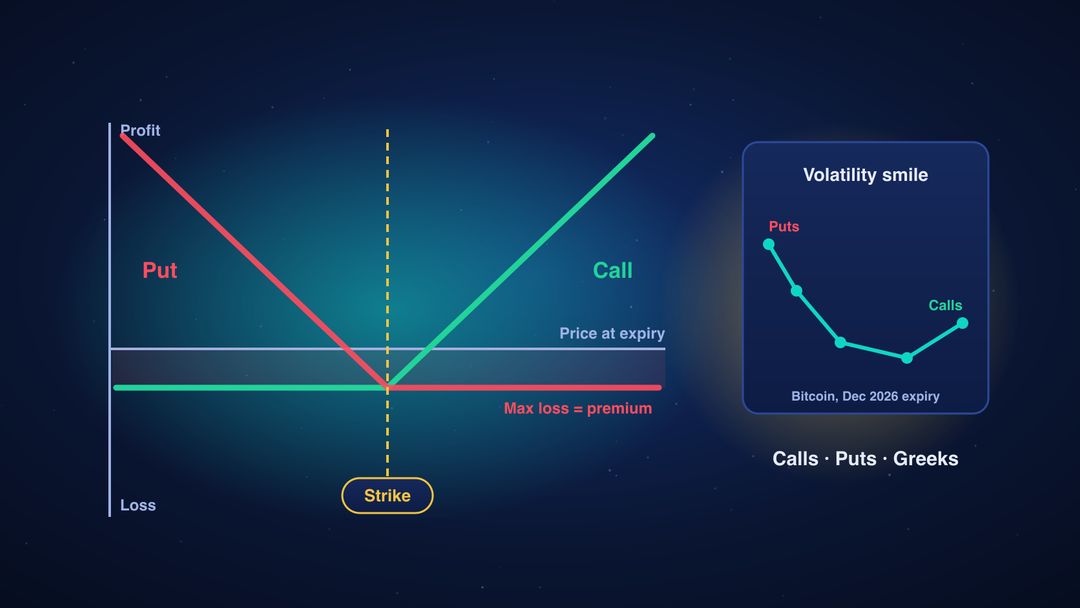
- Call option: the right to buy. You buy a call when you think the price will go up.
- Put option: the right to sell. You buy a put when you think the price will go down, or to protect coins you already own.
The words you need
- Strike price: the fixed price in the contract.
- Expiry: the date the option ends. Bitcoin options expire daily, weekly, monthly and quarterly, always at 08:00 GMT on Deribit.
- Premium: the price you pay to buy the option. It is the most a buyer can lose.
- Buyer (holder) and seller (writer): the buyer pays the premium and gets the right; the seller receives the premium and takes the obligation.
- In the money / out of the money: a call is in the money when the price is above the strike, and out of the money when it is below. For puts, it is the opposite.
- European vs American: European options can only be used at expiry; American options can be used any day. Crypto options on Deribit are European; US stock and ETF options are American.
- Cash-settled: most crypto options do not deliver coins. At expiry you simply receive the profit, if there is one.
A real example: buying a call
On November 2, a Bitcoin call with a $90,000 strike, expiring December 25, 2026, cost about $1,000 per Bitcoin.
- If Bitcoin is at $100,000 at expiry, the call is worth $10,000. Minus the $1,000 premium, your profit is $9,000, nine times your money.
- If Bitcoin is anywhere below $90,000, the call expires worthless and you lose the $1,000. Never more.
- You break even at $91,000: the strike plus the premium.
To make $9,000 by buying Bitcoin directly, you would need to risk $78,000. That is the appeal of options: leverage with a known maximum loss.
The catch: Bitcoin has to rise about 17% in less than eight weeks just for you to break even. Most out-of-the-money options expire worthless.
A real example: buying a put as insurance
You own 1 Bitcoin at $78,000 and worry about a crash. A $70,000 put expiring December 25 cost about $1,630, around 2% of your Bitcoin’s value.
- If Bitcoin crashes to $50,000, the put pays $20,000, and you can’t lose more than about $9,600 in total (the $8,000 drop to the strike plus the premium), however far it falls.
- If Bitcoin rises, you keep all the gains, minus the $1,630 you paid for the insurance.
That is exactly how insurance works: a small, certain cost to remove a large, uncertain loss.
Buyers and sellers
Every option has a seller on the other side. The seller collects the premium immediately and hopes the option expires worthless, which most do. But the seller’s risk is the mirror image of the buyer’s: limited gain, and potentially large losses.
That is why many exchanges only let experienced users sell options without owning the coins first, and why beginners should start by buying options or selling them only against coins they already hold.
Part 2: What sets the price of an option?
Intrinsic value and time value
An option’s price has two parts:
- Intrinsic value: what it would be worth if it expired right now. A $70,000 call with Bitcoin at $78,000 has $8,000 of intrinsic value. An out-of-the-money option has none.
- Time value: everything else. It is the price of the chance that the option becomes more valuable before expiry.
Time value shrinks every day. On November 2, the same $90,000 call cost $292 for the November 27 expiry but $998 for December 25. Four extra weeks more than tripled the price.
Volatility: the most important ingredient
The more the price swings, the more likely an option is to end up in the money, so the more it costs. Traders talk about two kinds of volatility:
- Realized volatility: how much the price actually moved in the past.
- Implied volatility (IV): how much the options market expects it to move, worked out from option prices. Options are often quoted in IV instead of dollars.
On November 2, at-the-money Bitcoin options for December implied about 38% volatility a year. Deribit’s volatility index, DVOL (the crypto version of Wall Street’s VIX), stood at 39.5 for Bitcoin and 52.9 for Ether, a sign that the market expected Ether to swing more.
A useful trick: implied volatility tells you the expected move. Multiply IV by the square root of the time left (in years). For December 25, that is 38% × √(53/365) ≈ 14.5%. The market was pricing a roughly two-in-three chance that Bitcoin ends between about $67,000 and $89,000 on Christmas Day.
Part 3: The Greeks
The Greeks measure how an option’s price reacts to changes. You don’t need the formulas, just the intuition.
- Delta: how much the option moves when the price moves by $1. A delta of 0.5 means the option gains $0.50 for every $1 Bitcoin rises. The December $90,000 call had a delta of about 0.18. Delta is also a rough estimate of the chance of ending in the money (about 18% here).
- Gamma: how fast delta changes. Gamma is highest for at-the-money options close to expiry, which is why their prices can jump wildly on expiry day.
- Theta: how much value the option loses each day from time passing. Option buyers pay theta; sellers earn it. Theta speeds up in the final weeks.
- Vega: how much the price changes when implied volatility moves by one point. Long-dated options have the most vega. You can make or lose money on an option just because IV changes, even if the price doesn’t move.
A classic beginner mistake: buying calls just before big news, seeing the price go up as expected, and still losing money. Before the news, IV is high. After it, IV collapses (traders call it “IV crush”), and the vega loss wipes out the gain.
Part 4: Six common strategies
1. Long call or long put
Buy a call if you are bullish, or a put if you are bearish. Simple, limited risk, but you need a big enough move, soon enough.
2. Protective put
Own the coin and buy a put below the current price, like the $70,000 insurance example above. Many funds hedge this way before major events, such as Fed decisions.
3. Covered call
Own the coin and sell a call above the current price. On November 2, selling the December $90,000 call against 1 Bitcoin paid about $1,000, around 1.3% in under eight weeks. If Bitcoin stays below $90,000, you keep the premium and your coin. If it rises above, you have effectively sold at $90,000 (plus the premium). Popular with long-term holders who want income; the cost is giving up big rallies.
4. Cash-secured put
Hold cash and sell a put at a price where you would happily buy. You get paid while you wait. If the price drops below the strike, you buy the coin at the strike, minus the premium you already collected.
5. Spreads
Buy one option and sell another to make the trade cheaper. A bull call spread buys the $80,000 call (about $3,720) and sells the $90,000 call (about $1,000), for a net cost of $2,720. The most you can make is $10,000 − $2,720 = $7,280, if Bitcoin ends above $90,000. Cheaper than a single call, in exchange for capping your upside.
6. Straddles and strangles
Buy both a call and a put. A straddle uses the same strike; a strangle uses a higher call and a lower put. You profit if the price moves a lot in either direction. It is a bet on volatility, not on direction, and it loses if the price goes nowhere.
A collar is a popular combination: own the coin, buy a put below and sell a call above. The call premium pays for the put, so the protection is almost free, but your upside is capped.
Advanced: how professionals read the options market
Volatility skew
If options were priced by a simple model, every strike would have the same implied volatility. In reality, they don’t. On November 2, December Bitcoin options were priced at:
| Option (Dec 25) | Strike | Implied volatility |
|---|---|---|
| Put | $65,000 | 45.6% |
| Put | $70,000 | 42.0% |
| At the money | $78,000 | 38.0% |
| Call | $90,000 | 36.8% |
| Call | $100,000 | 39.5% |
Puts were noticeably more expensive than calls the same distance away. Traders were paying up for crash protection, a defensive mood. In euphoric markets the opposite happens, and calls become the expensive side. Skew is usually summed up as the 25-delta risk reversal: the IV of a 25-delta call minus a 25-delta put. Negative means fear; positive means greed.
Term structure
Implied volatility also differs by expiry. Normally longer expiries carry slightly higher IV (more time, more things can happen). When short-dated IV jumps above long-dated IV, the curve is inverted: the market is bracing for something now, such as a crash, a Fed meeting or an ETF decision. On November 2 the curve was calm: about 38% for December and 39% for March.
Put/call ratio
The put/call ratio compares open puts with open calls. On Deribit on November 2 it was 0.68 for Bitcoin and 0.55 for Ether, so there were clearly more calls than puts. A low ratio shows bullish positioning; a very high one shows fear. Extreme readings are often read as contrarian signals, because when everyone is positioned one way, the market tends to surprise them.
Open interest and big expiries
Open interest is the number of option contracts still open. It tends to cluster at round strikes and big dates. On November 2:
- 45% of all Bitcoin options open on Deribit expired on December 25, the year’s big quarterly expiry.
- The most popular strikes were the $90,000 call and the $60,000 put: where traders were placing their biggest bets and their deepest hedges.
Large expiries can move the market in the days around them, as positions are closed or rolled into the next date.
Max pain
Max pain is the strike at which the most option value would expire worthless, and so where option buyers in total would lose the most. Some traders believe prices drift toward max pain before a big expiry. The evidence is mixed, but it is widely watched, especially before end-of-month and quarterly expiries.
Dealer gamma
The big market makers who sell most options hedge their risk by buying or selling the coin itself. When they are long gamma, they buy dips and sell rallies, which calms the market and can “pin” the price near popular strikes. When they are short gamma, they have to sell into falls and buy into rises, which makes moves bigger. Some of the sharpest crypto moves happen when the price breaks through a level where dealers are short gamma.
Options vs futures
Options and futures are both derivatives, but they behave very differently. A futures position loses money step by step and can be liquidated; a bought option can only lose its premium. In 2026, open interest in Bitcoin options has been larger than in Bitcoin futures, which some analysts link to calmer price swings: hedged traders are less likely to be forced to sell. You can follow the futures side on our Leverage & Liquidations dashboard.
Where crypto options trade
- Deribit: the original crypto options exchange, bought by Coinbase in 2025. Options on Bitcoin, Ether, Solana and more, settled at 08:00 GMT.
- IBIT options: options on BlackRock’s iShares Bitcoin Trust, listed on Nasdaq since November 2024. Bought through a regular stock broker and regulated like any US stock option. By early 2026 they made up about half of all Bitcoin options open interest.
- CME: regulated options on Bitcoin and Ether futures, used mainly by institutions.
- Binance, OKX and Bybit: options sections inside the big crypto exchanges.
- On-chain options: DeFi protocols such as Derive let you trade options from your own wallet. Smaller and less liquid, with smart-contract risk on top.
Rules before your first trade
- Only buy options with money you can lose completely. That is the most common outcome.
- Avoid selling “naked” options (without owning the coin or holding the cash). The losses can be much bigger than the premium.
- Watch implied volatility, not just the price. Buying when IV is high means paying for expensive insurance.
- Start small and short. Try one contract, or a fraction of one, and learn how the price moves with time and volatility.
- Mind the fees and the spread. Thin markets for far-away strikes can be expensive to get in and out of.
The takeaway
For beginners, options are a way to bet on a move with a known maximum loss, or to insure what you already own. For advanced traders, the options market is also one of the best sentiment indicators there is: skew, the put/call ratio and the size of upcoming expiries show what the market fears and hopes, often before it shows up in the price.
Options are complex and risky, and most option buyers lose money. This article is for information only and is not financial advice. Prices quoted are from Deribit on November 2, 2026.
Frequently asked questions
What is a crypto option?
An option is a contract that gives you the right, but not the obligation, to buy or sell at a fixed price before or on a fixed date. You pay a premium upfront for that right.
What is the difference between a call and a put?
A call is the right to buy, used when you think the price will rise. A put is the right to sell, used when you think it will fall or to protect coins you own.
How much can you lose buying options?
A buyer can lose at most the premium paid, and losing all of it is the most common outcome. Sellers face the opposite: limited gain and potentially large losses.
What is implied volatility?
Implied volatility is how much the options market expects a price to move, worked out from option prices. Higher implied volatility makes options more expensive.
What is IV crush?
It is the collapse in implied volatility after big news. Traders can buy calls before the news, see the price rise as expected, and still lose money because the option lost value.
What is volatility skew?
Skew is the gap in implied volatility between strikes. When puts cost more than calls the same distance away, traders are paying for crash protection, which signals a defensive mood.
Where can you trade crypto options?
On Deribit, through IBIT options at a regular stock broker, on CME, in the options sections of Binance, OKX and Bybit, and on on-chain protocols such as Derive.