The United States owes more money than any government in history. On October 28, 2026, the US Treasury reported a total debt of $40.55 trillion. That is roughly $118,000 for every person in the country, and it keeps growing by about $6.8 billion a day.
Here is what that number means, how it got so big, who actually lends the money, and why investors (including crypto investors) watch it closely.
Where the number comes from
The government spends more than it collects in taxes almost every year. The gap is the deficit, and the Treasury covers it by borrowing: it sells bonds, notes and bills (together called Treasuries) to investors. All that borrowing, added up over the years, is the debt.
In fiscal year 2026, which ended on September 30, the government took in $5.40 trillion and spent $7.40 trillion. The deficit was $1.99 trillion, about 12% more than the year before and around 6% of the economy.
The total debt has two parts:
- Debt held by the public: $32.7 trillion. Money borrowed from investors, banks, funds, foreign governments and the Federal Reserve. This is the part economists usually mean.
- Intragovernmental debt: $7.9 trillion. Money the government owes to its own trust funds, such as Social Security.
How fast it has grown
Total US debt, according to the Treasury:
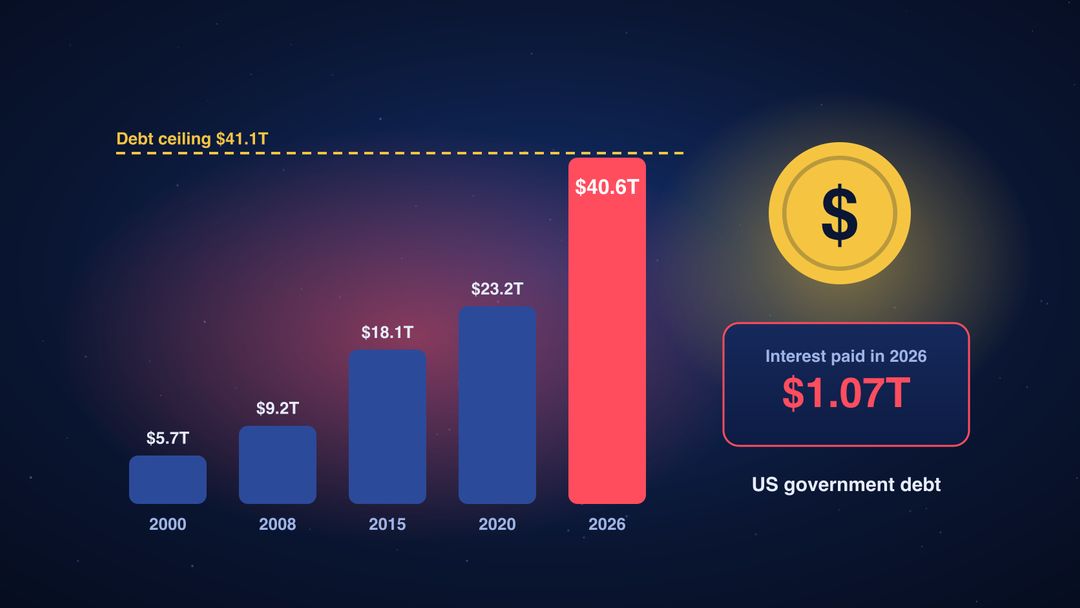
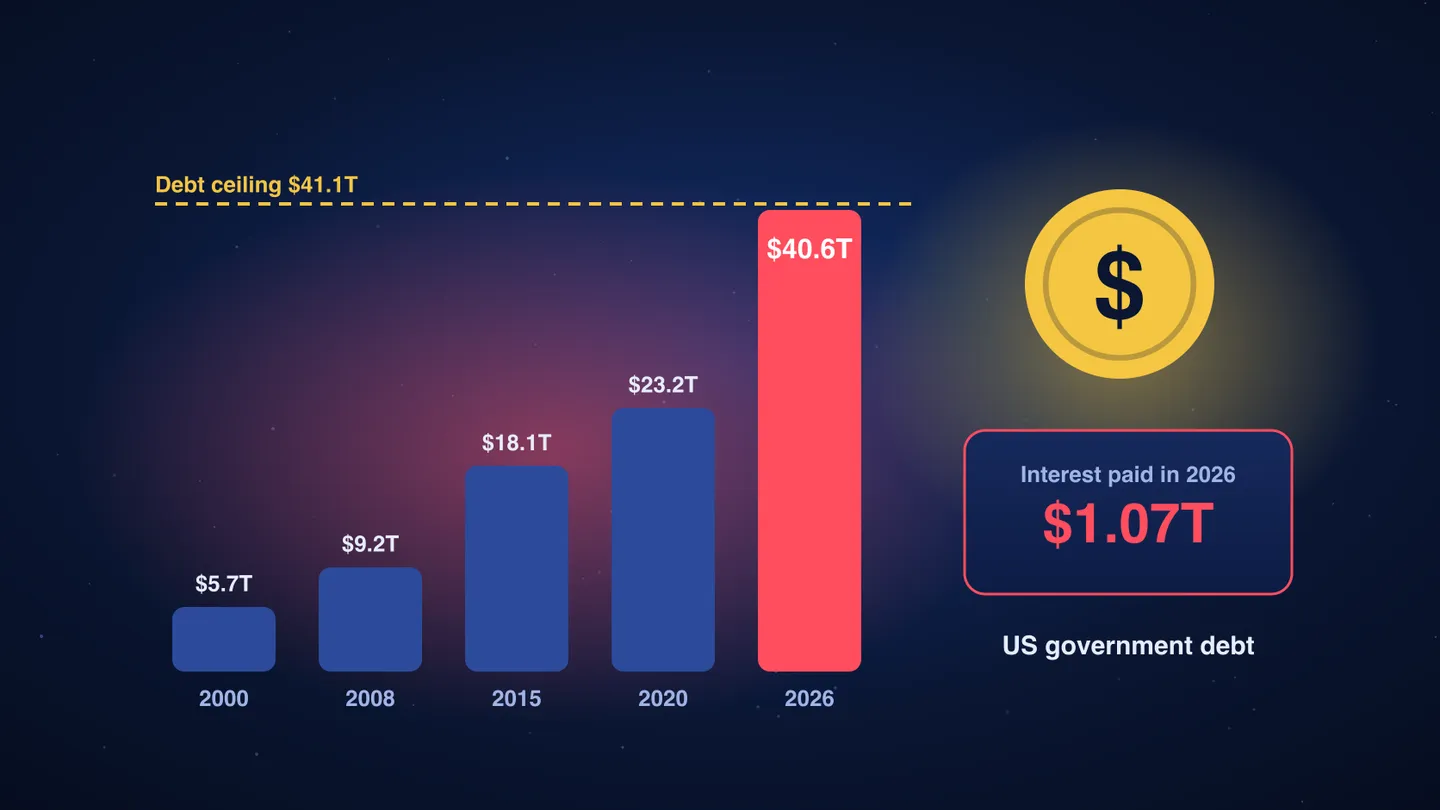
- 2000: $5.7 trillion
- 2008: $9.2 trillion
- 2015: $18.1 trillion
- 2020: $23.2 trillion
- 2026: $40.6 trillion
The debt grew by 60% between 2000 and 2008, doubled between 2008 and 2015, and has grown by another $17 trillion since the start of 2020. Two crises (2008 and the pandemic) did most of the damage, but the deficits never went away once each crisis passed. In the last year alone the debt grew by almost $2.5 trillion.
Measured against the size of the economy, the debt held by the public is now about 100% of US GDP, close to the record of 106% set just after World War II.
Who owns the debt?
Of the $32.7 trillion held by the public:
- Foreign investors: about $9.3 trillion (29%). The largest are Japan ($1.07 trillion), the United Kingdom ($1.01 trillion) and China ($591 billion, down from over $1 trillion a decade ago).
- The Federal Reserve: about $4.6 trillion (14%). The Fed bought huge amounts during the 2008 and 2020 crises.
- Everyone else in the US: the rest (around 57%). Banks, money market funds, pension funds, insurers, mutual funds, states, companies and ordinary savers.
A newer buyer is crypto. Dollar stablecoins like USDT and USDC keep most of their reserves in short-term Treasury bills. Tether alone reported about $141 billion of Treasury bill exposure at the end of March 2026, more than many countries hold. Under the US stablecoin law passed in 2025 (the GENIUS Act), regulated stablecoins must be backed by cash and short-term Treasuries, so every new digital dollar is also a small loan to the US government.
The real problem: interest
Debt is only dangerous if paying for it becomes a burden. That is exactly what is changing.
In fiscal year 2026 the Treasury paid $1.07 trillion in interest to the holders of its debt, up from $974 billion the year before. Interest is now one of the biggest items in the whole budget, larger than what the US spends on defense.
The reason is simple: rates went up. In December 2021 the average interest rate on all US debt was 1.57%. By September 2026 it was 3.53%. Every year, trillions of dollars of old, cheap debt mature and have to be refinanced at today’s higher rates, so the interest bill keeps climbing even if nothing else changes.
That creates a loop: the government borrows more to pay interest, which means more debt, which means more interest.
The debt ceiling
Congress sets a legal limit on how much the Treasury can borrow, called the debt ceiling. The current limit is $41.1 trillion, set by a law signed in July 2025. With the debt where it is now, the remaining room is less than $1 trillion, and the Congressional Research Service expects the US to approach the limit during fiscal year 2027.
When the ceiling is hit, the Treasury uses temporary accounting tricks (called “extraordinary measures”) to keep paying its bills for a few months while Congress negotiates. These standoffs have repeatedly shaken markets, and the US credit rating has been cut from the top level by all three major agencies, most recently by Moody’s in May 2025.
Why it matters for investors
- Interest rates: a government that borrows this much competes with everyone else for money. Heavy issuance of Treasuries can push up the rates on mortgages and business loans.
- Markets: debt-ceiling fights, rating cuts or weak bond auctions can trigger sudden sell-offs in both stocks and bonds.
- The dollar: if investors start to doubt that the US will manage its debt responsibly, they may demand higher rates to hold dollars, or look for alternatives such as gold.
- Inflation risk: the easiest way to shrink a debt in real terms is to let inflation erode it. That is good for borrowers, but bad for anyone holding cash or bonds.
What it means for crypto
The US debt is one of the main arguments behind Bitcoin. Supporters point to the contrast: only 21 million bitcoin will ever exist, while the supply of US debt (and of dollars) keeps growing. When worries about debt and inflation rise, some investors buy Bitcoin and gold as a hedge.
There is a twist, though. Crypto is also becoming one of the debt’s customers. The bigger the stablecoin market grows, the more Treasury bills it needs to hold, which ties the health of the crypto market more closely to the health of the US bond market.
The takeaway
The US is not about to run out of money: it borrows in its own currency, and Treasuries remain the world’s main safe asset. But with debt at 100% of GDP and an interest bill above $1 trillion a year, the room for mistakes is getting smaller. For investors, the debt is no longer background noise. It shapes interest rates, the dollar, and the case for assets like Bitcoin.
This article is for information only. It is not financial advice.