A mystery begins
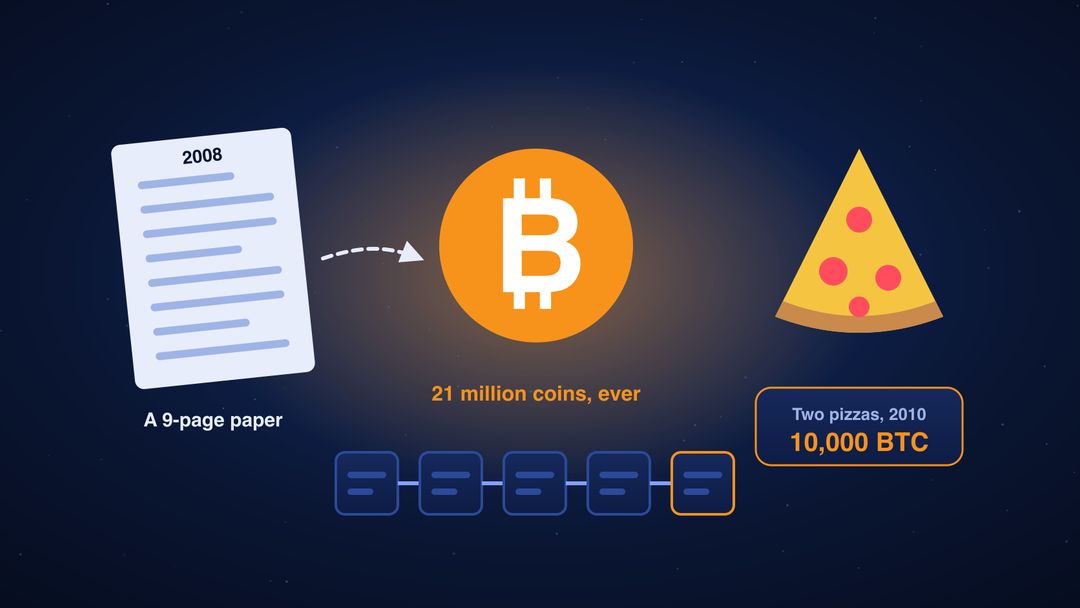
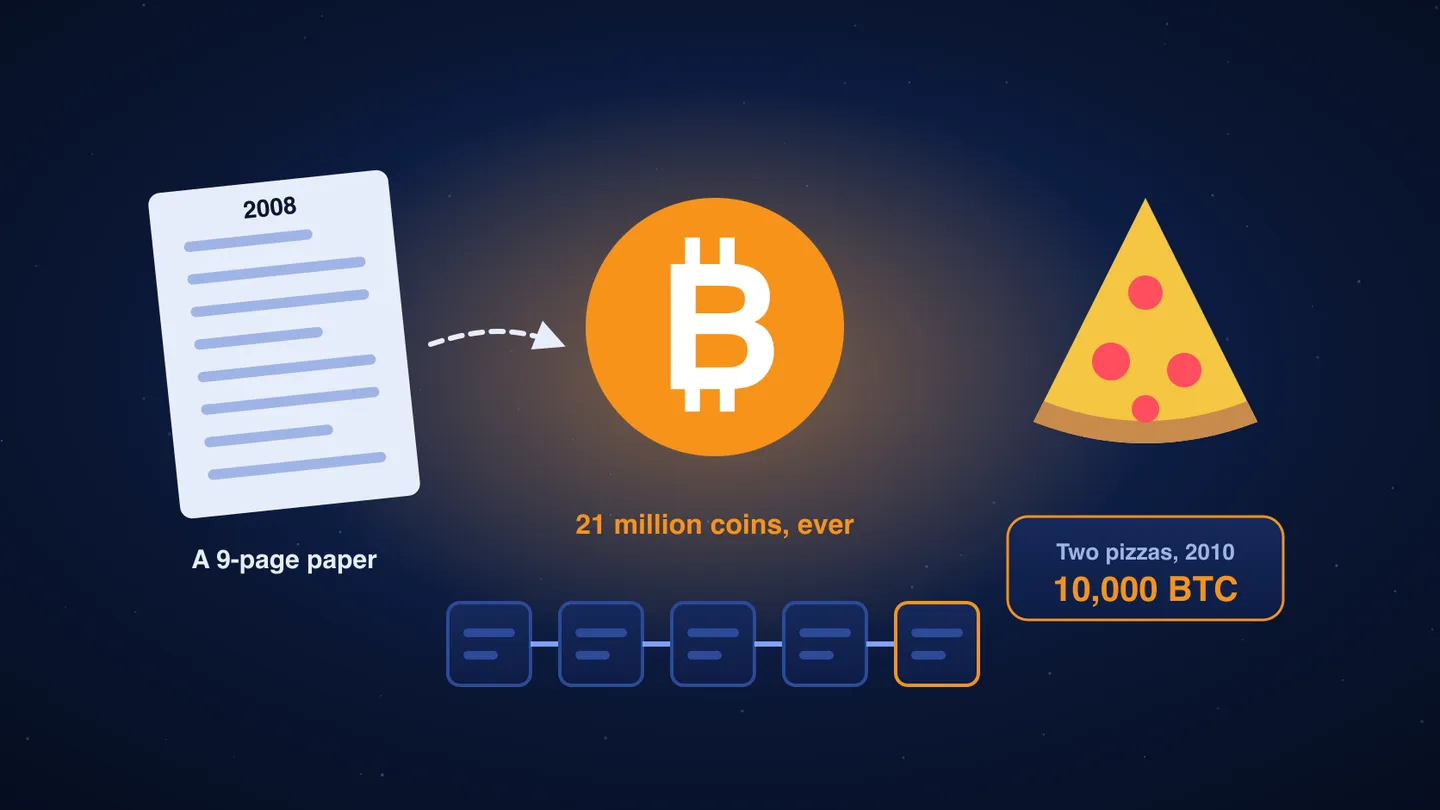
In October 2008, mid-financial-crisis, an unknown person called Satoshi Nakamoto shared a nine-page paper proposing money with no banks. On January 3, 2009, Satoshi mined the first block and embedded a headline: “Chancellor on brink of second bailout for banks.”
The $700 million pizza
For a year, Bitcoin was nearly worthless. In May 2010, programmer Laszlo Hanyecz paid 10,000 BTC for two pizzas. Today that’s a fortune, and the date is celebrated as Bitcoin Pizza Day.
How mining works
Every ten minutes, miners bundle transactions into a block and race to find a number that makes the block’s hash start with a long string of zeros. There’s no shortcut, only trillions of guesses per second. The winner adds the block and collects the reward. The difficulty auto-adjusts every two weeks, so blocks keep coming every ten minutes no matter how much power joins.
What it takes
- Hardware: Satoshi mined on a normal PC. Today only specialized ASIC chips stand a chance.
- Electricity: The real cost. The network uses as much power as a mid-sized country.
- Cheap energy: Winners hunt for hydro dams, surplus wind and solar, or flared gas.
Is it still worth it?
For most people, no. The reward is now 3.125 BTC per block (after the 2024 halving), and home miners compete against industrial farms with cents-per-kWh power. Pools help, but margins are thin unless your electricity is very cheap. Some hobbyists still run tiny “lottery miners” for the microscopic chance of hitting a block alone, and a few have won.
Boom and bust
Bitcoin hit $1,000 in 2013, then lost its biggest exchange when Mt. Gox collapsed in 2014 (it began as a Magic: The Gathering card site). It neared $20,000 in 2017, peaked near $69,000 in 2021 with Tesla and El Salvador on board, and survived the FTX scandal in 2022. In 2024, US spot ETFs finally let ordinary investors buy through a regular brokerage.
The takeaway
Bitcoin’s paradox: mining is deliberately wasteful, and that waste is what makes it secure. To rewrite history, an attacker would have to outspend the entire network, so energy becomes trust. Only 21 million coins will ever exist, and the last one won’t be mined until around 2140.
A nine-page paper from someone nobody can identify turned electricity into digital scarcity, with no CEO and no headquarters. Digital gold, bubble, or future of money, nobody has seen an experiment quite like it.