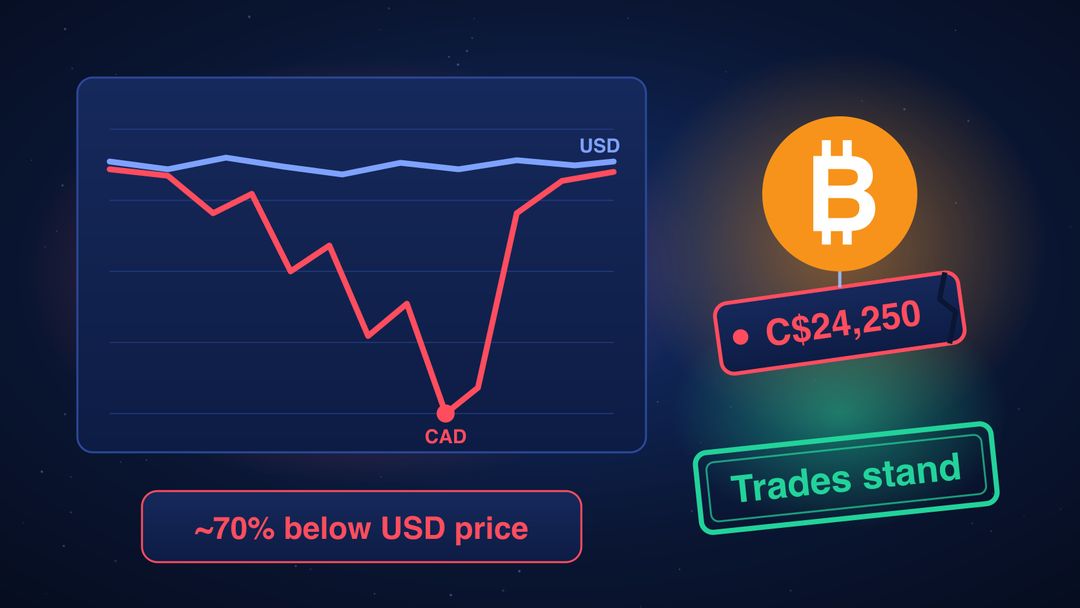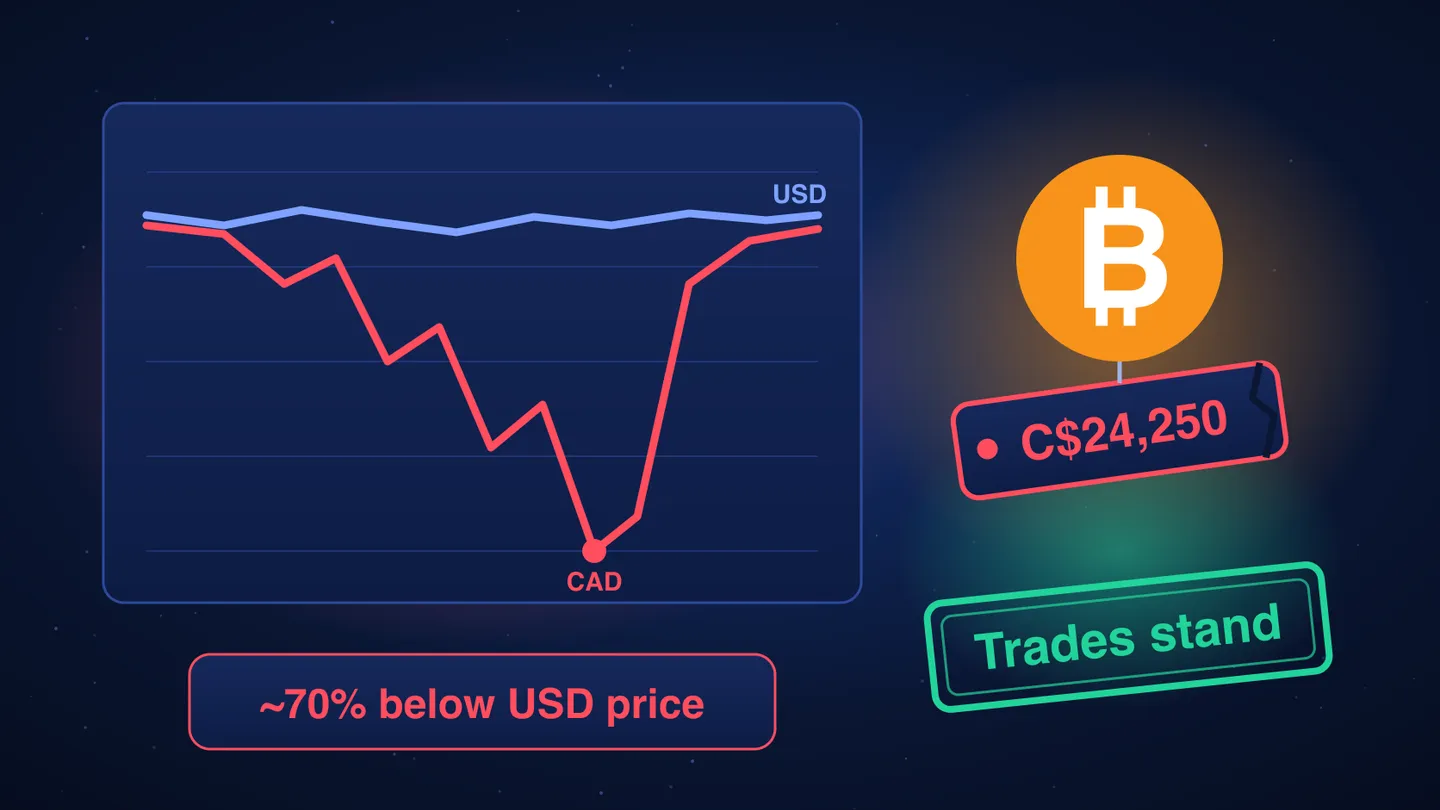
For about 14 hours between Friday, November 20 and Saturday, November 21, 2026, prices on Kraken’s Canadian-dollar (CAD) markets broke away from the rest of the world. At the lowest point, bitcoin traded for C$24,250, which is about $16,900 in US dollars. On Kraken’s own US-dollar market, bitcoin was trading near $57,500 at the same time. Kraken, one of the largest crypto exchanges, says its systems worked as designed and that the trades will not be reversed.
Key facts
- When it started: Kraken says heavy selling hit its CAD trading pairs from about 3 p.m. ET (20:00 GMT) on Friday, pushing their prices well below other markets.
- The low: bitcoin bottomed at C$24,250 in the hour starting 3 a.m. ET (08:00 GMT) on Saturday, according to Kraken’s public price data. Before the selloff it traded around C$83,000–84,000.
- The dollar itself broke: on Kraken’s US dollar / Canadian dollar market, one US dollar briefly sold for about C$0.30, against roughly C$1.43 before. That is why every coin priced in Canadian dollars on Kraken looked far cheaper than elsewhere.
- Not only bitcoin: ether on the CAD market fell as low as about C$796, from roughly C$2,300 before the selloff.
- The rest of the market was calm: Kraken’s bitcoin price in US dollars stayed between about $55,100 and $59,100 during the whole episode.
- Back to normal: CAD prices returned close to normal levels by mid-morning GMT on Saturday.
What Kraken said
In a statement from its support account on Saturday, Kraken said every order was processed correctly and its security teams found no sign of a breach or of hacked accounts. “Executed trades stand,” the exchange said. That means people who sold bitcoin or ether far below the normal price will not get their coins back, and people who bought at those prices keep their bargains.
Kraken has not explained what caused the selloff, who was selling, or how many coins changed hands at the lowest prices.
Why it matters
The episode shows how a single, smaller market inside a big exchange can drift far from the real price when there are not enough buyers and sellers to keep it in line. Anyone with an automatic order, such as a stop-loss that sells when the price falls to a set level, could have sold at a fraction of the true value. Because exchanges usually treat completed trades as final, losses like these are rarely refunded. For traders, the lesson is to check how busy a market is before trading on it, and to be careful with automatic sell orders on quieter currency pairs, especially on weekends.
This article is for information only and is not financial advice.