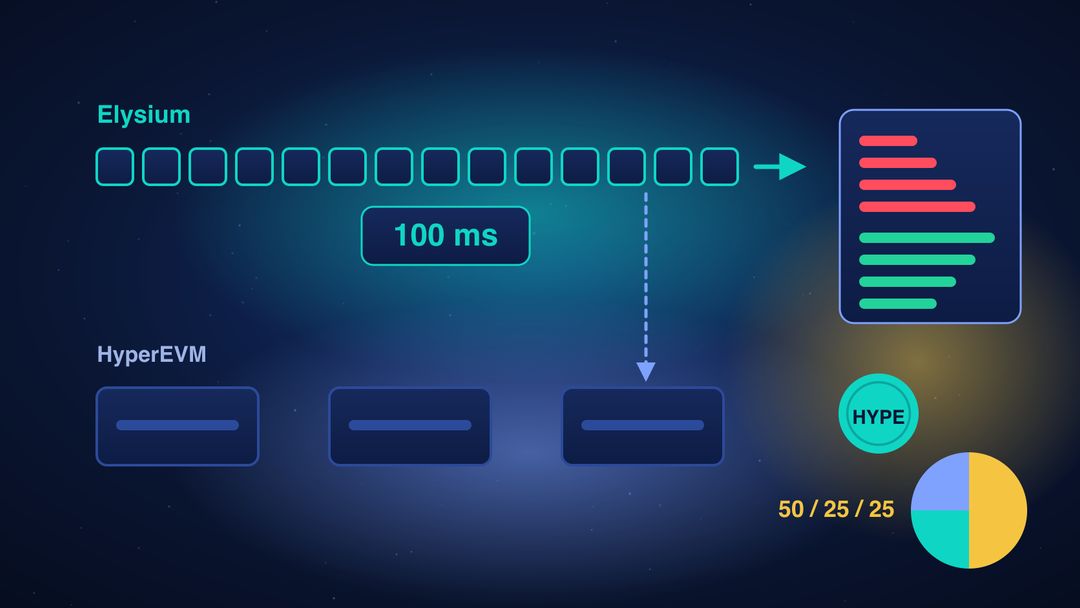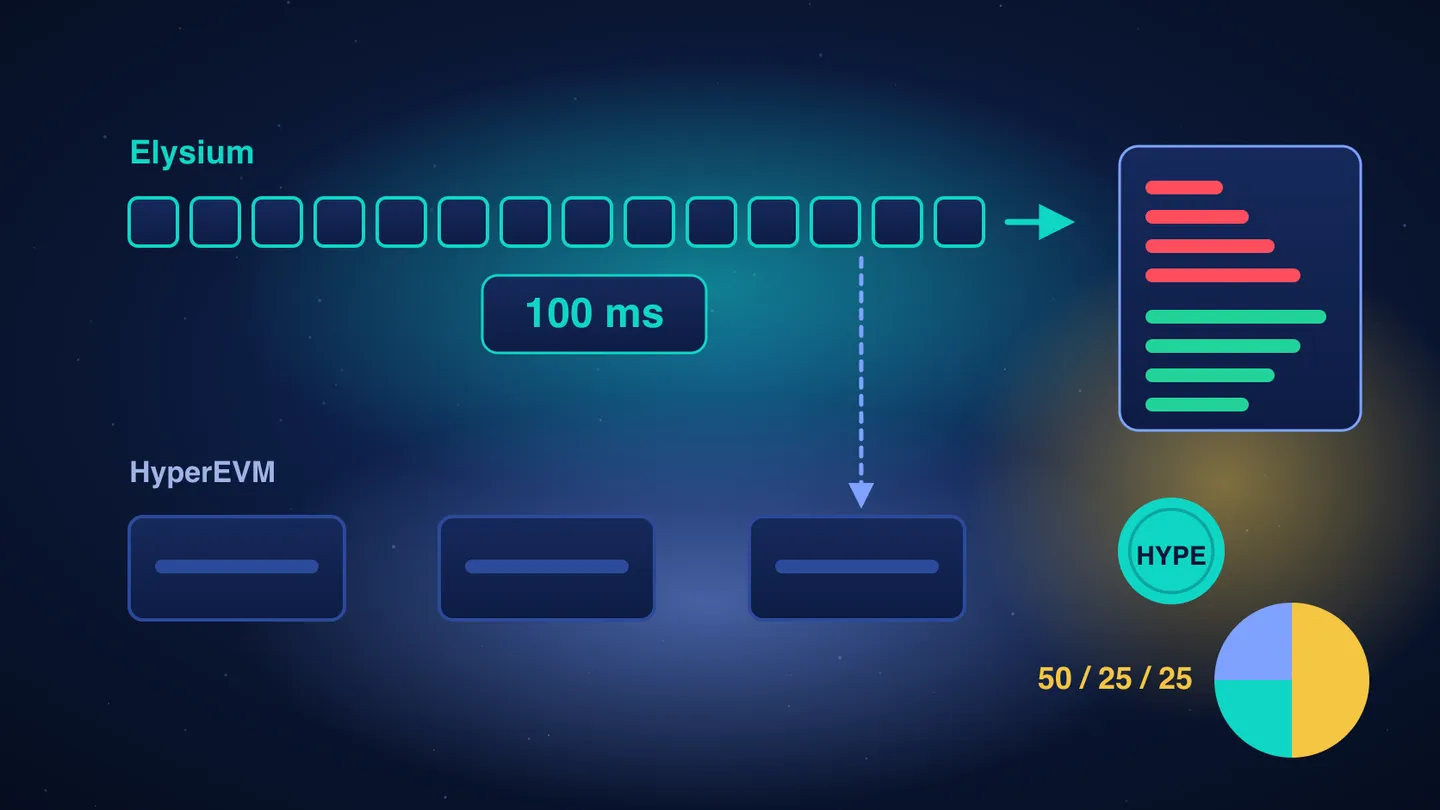
Elysium, a new blockchain built on top of Hyperliquid by the liquid-staking protocol Kinetiq, opens its public mainnet today, Monday, November 9, 2026. It is designed as a “fast lane” for Hyperliquid apps: much quicker blocks and far more capacity than Hyperliquid’s own smart-contract chain, while staying inside the Hyperliquid ecosystem and using HYPE to pay fees.
Key facts
- What it is: a Layer 2 (a chain that runs on top of another chain and settles back to it). It is built with Arbitrum’s Orbit technology and settles to HyperEVM, Hyperliquid’s smart-contract chain.
- Speed: blocks every 100 milliseconds and a target of 300 million gas per second. For comparison, HyperEVM makes small blocks every second (3 million gas each) and large blocks about every minute (30 million gas).
- Fees: paid in HYPE, Hyperliquid’s own coin. There is no separate gas token.
- Moving money in and out: HYPE and any token on HyperEVM can be bridged to Elysium 1:1. Tokens launched on Elysium can travel back to HyperEVM and from there reach Hyperliquid’s spot markets. Withdrawals through the official bridge are final only after a challenge period of about 5.5 days.
- For developers: existing Ethereum code and tools work without changes.
- Testnet: a public test network has been running since late September.
Who is behind it
Kinetiq is a liquid-staking protocol on Hyperliquid: users stake HYPE and receive kHYPE, a token that keeps earning staking rewards while it can still be used elsewhere. Kinetiq says it is the largest HYPE liquid-staking protocol. Its governance token is KNTQ.
Where the fees go
Elysium earns money from transaction fees collected by its sequencer (the computer that puts transactions in order). Kinetiq plans to split that revenue:
| Share | Goes to |
|---|---|
| 50% | buying KNTQ on the open market, sent to Hyperliquid’s Assistance Fund and taken out of circulation for good |
| 25% | builders: paid automatically to the apps whose contracts use the chain |
| 25% | running the network |
Paying apps a share of the fees they generate is unusual and is meant to attract builders.
What comes next
About four weeks after mainnet, a network upgrade is planned that lets apps on Elysium:
- read Hyperliquid’s order books directly: live prices, full depth, balances and positions, with no outside price feeds (oracles);
- place orders on Hyperliquid in about 100–200 milliseconds through a trade-only agent linked to the user’s own account, so the user’s money never changes hands.
Later steps include more independent checks of the chain (fraud proofs through Arbitrum’s BoLD system), more members in the group that stores its data, and more audits.
Who is joining at launch
Partners have announced day-one support on X, among them Bitget Wallet, the cross-chain service Mayan, the trading app fomo, the aggregator Oku (which says it will use 40% of its net trading fees to buy back and burn KNTQ) and CoinGecko, which tracks Elysium data from launch.
What it brings to the market
Hyperliquid is best known for its very fast trading of perpetual futures on its main engine, HyperCore. Its smart-contract chain, HyperEVM, was deliberately kept small, which leaves little room for apps that need many quick transactions. Elysium tries to fill that gap: spot trading, new token launches, automated market makers and trading tools that can work right next to Hyperliquid’s order books. Kinetiq says the chain “relieves” HyperEVM rather than competing with it, and that more activity on Elysium should bring more trading volume and new listings back to Hyperliquid.
It also adds a new kind of link between a Layer 2 and an exchange: if the planned upgrade arrives, apps will be able to use Hyperliquid’s real order books inside their own code.
What it means for users
- Faster and cheaper apps. Trades and transfers should confirm in a fraction of a second, with low fees paid in HYPE.
- Nothing new to buy for fees. If you hold HYPE, you can pay for transactions on Elysium.
- More things to do with HYPE. New exchanges, launchpads and trading tools are expected on the chain, and later apps that trade directly on Hyperliquid.
- Early-stage risks. At launch, Elysium runs with a single sequencer, a single data storage operator and a permissioned set of validators. That is common for new Layer 2s but means more trust in the operators for now. Bridging back through the official bridge takes about 5.5 days.
- No Elysium token. There is no Elysium token and no official points program. Treat any “Elysium token” or “Elysium airdrop” offer as a likely scam, and use only the official site and X accounts.
Why it matters
Elysium is a bet that Hyperliquid’s ecosystem has outgrown its own smart-contract chain. If apps and users move in, it could make Hyperliquid a broader on-chain marketplace, not just a futures exchange. The key tests are the order-book upgrade promised in about a month, and how quickly the chain moves away from its single-operator setup.
This article is for information only and is not financial advice.