Bitcoin ETF Flows
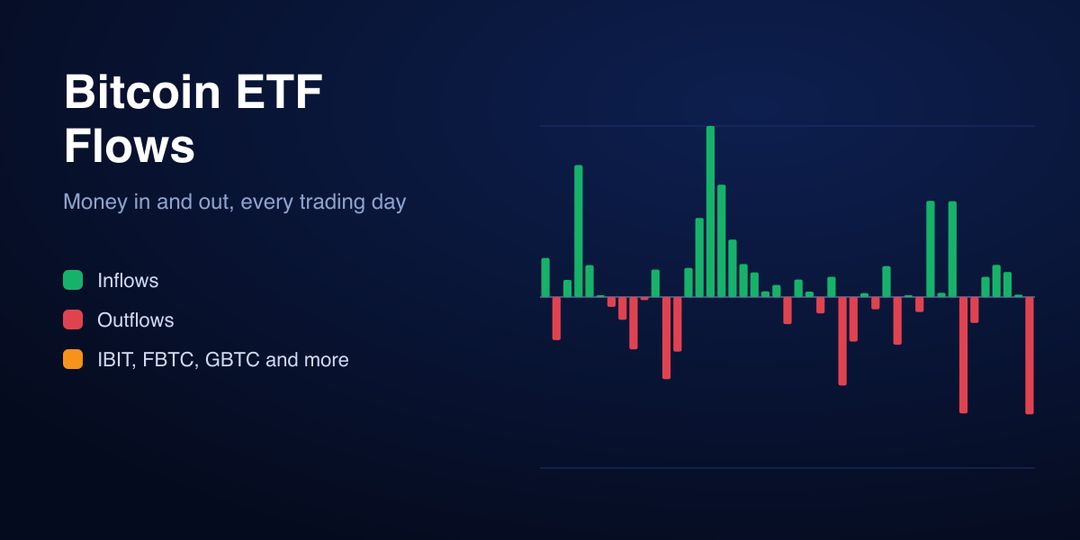
How much money goes into and out of the US spot Bitcoin ETFs every trading day. When investors buy ETF shares, the funds buy Bitcoin; when they sell, the funds sell. It is the clearest daily sign of what big US investors are doing with Bitcoin.
6 outflow days in a row · 29 of the last 63 trading days had inflows
The last 20 trading days. Bitcoin closed at $61,211. Updated 25 Nov 2026.
Money in and out
Green bars are inflows, red bars outflows, for all the US spot Bitcoin ETFs together. Switch on the running total to see how much stayed in over the period.
Records
Assets held by the ETFs
The value of everything the US Bitcoin ETFs hold. It moves with the Bitcoin price as much as with flows: when Bitcoin falls, assets fall even if nobody sells.
Every US spot Bitcoin ETF
Ranked by assets on 24 Nov 2026. Bitcoin held is estimated from assets at today’s price. The fee is what the fund charges each year; the premium or discount is how far the share price was from the value of its Bitcoin.
| # | Fund | Issuer | Assets | Share | ≈ Bitcoin | Fee / year | Premium | Volume |
|---|---|---|---|---|---|---|---|---|
| 1 | IBITiShares Bitcoin Trust | BlackRock | $45.3B | 57% | 739,510 | 0.25% | −0.10% | $35M |
| 2 | FBTCFidelity Wise Origin Bitcoin Fund | Fidelity | $14.9B | 19% | 243,772 | 0.25% | +0.43% | $831K |
| 3 | GBTCGrayscale Bitcoin Trust ETF | Grayscale | $7.23B | 9.1% | 118,177 | 1.5% | +0.02% | $248K |
| 4 | BTCGrayscale Bitcoin Mini Trust ETF | Grayscale | $5.42B | 6.8% | 88,614 | 0.15% | +0.09% | $78K |
| 5 | BITBBitwise Bitcoin ETF | Bitwise | $2.53B | 3.2% | 41,316 | 0.2% | −0.12% | $80K |
| 6 | ARKBARK 21Shares Bitcoin ETF | ARK & 21Shares | $1.61B | 2.0% | 26,374 | 0.21% | +0.16% | $96K |
| 7 | HODLVanEck Bitcoin ETF | VanEck | $848M | 1.1% | 13,858 | 0% | +0.13% | $1K |
| 8 | BRRRCoinShares Bitcoin ETF | CoinShares | $472M | 0.6% | 7,713 | 0.25% | +0.02% | $0K |
| 9 | BTCOInvesco Galaxy Bitcoin ETF | Invesco Galaxy | $422M | 0.5% | 6,891 | 0.39% | +0.02% | $2K |
| 10 | EZBCFranklin Bitcoin ETF | Franklin Templeton | $366M | 0.5% | 5,982 | 0.19% | +0.13% | $1K |
| 11 | BTCWWisdomTree Bitcoin Fund | WisdomTree | $168M | 0.2% | 2,741 | 0.3% | +0.20% | $0K |
Not in the table: 6 US ETFs that hold Bitcoin futures contracts, not Bitcoin itself (BITO $1.62B, BITS $23M, ARKA $8M, DEFI $5M, BITC $5M, ARKC $1M). They count in the assets chart above, but not in the flows.
How ETF flows work
- Inflow. Investors buy more ETF shares than are sold. Big trading firms create new shares and the fund buys Bitcoin to back them.
- Outflow. More shares are sold than bought. Shares are redeemed and the fund sells Bitcoin (or hands it back) to pay out.
- Net flow. Inflows minus outflows, for all funds together. One fund’s outflow can be another’s inflow when investors switch, as many did from Grayscale’s expensive GBTC in 2024.
Since early 2024 the funds have taken in $52.1B more than they paid out, and hold ≈1,294,947 BTC.
How to read them
- Look at streaks and weeks, not single days. One big day can be one large investor; a run of days in the same direction is a trend.
- Flows often follow the price. Inflows tend to come after Bitcoin has risen and outflows after it has fallen, so they confirm a move more than predict it.
- Watch the big events. Fed decisions (see FOMC & Crypto), hacks and big liquidations (see Leverage & Liquidations) often show up in the next day’s flows.
Companies buy Bitcoin too: see Bitcoin Treasury Companies.
Frequently asked questions
What are Bitcoin ETF flows?
The money investors put into (inflows) or take out of (outflows) the Bitcoin ETFs on a trading day, in US dollars. An inflow means new ETF shares were created and the fund bought Bitcoin to back them; an outflow means shares were redeemed and the fund sold Bitcoin or handed it back.
Why do ETF flows matter for the Bitcoin price?
Big, steady inflows mean the funds are buying Bitcoin in the market, often more than miners produce; long outflow streaks mean they are selling. Flows also show the mood of large investors in the US. But they often follow the price as much as they lead it, so one day on its own says little.
When are the flows published?
After the US stock market closes (4 pm New York time). Some funds report a day late, so the latest day can still change a little. There are no flows on weekends or US market holidays.
Which is the biggest Bitcoin ETF?
BlackRock’s IBIT (iShares Bitcoin Trust), with $45.3B in assets, ≈739,510 BTC: 57% of all the money in US spot Bitcoin ETFs on 24 Nov 2026.
Is buying a Bitcoin ETF the same as buying Bitcoin?
It gives you the price of Bitcoin through a normal brokerage account, without keys to look after, but you pay a yearly fee, can only trade when the stock market is open, and you can’t send or spend the Bitcoin. If you want to hold the coins yourself, see Self-custody basics.
Data: CoinMarketCap (net flows of all US spot Bitcoin ETFs, assets, and each fund’s fee, premium and volume), updated when the page is built. CoinMarketCap does not publish flows per fund. Trackers count slightly differently, so other sites can show a slightly different number for the same day; the newest day can still be revised. Monthly figures start in February 2024 (the funds opened on 11 January 2024). Not financial advice.