Overview
Sui is a Layer 1 blockchain, which means it runs its own network rather than being built on top of Ethereum or another chain. Its mainnet launched in May 2023. It was built by Mysten Labs, a company founded in 2021 by former engineers from Meta’s Diem and Novi projects, including CEO Evan Cheng and Sam Blackshear, who created the Move programming language.
The goal is simple to state and hard to deliver: a blockchain fast and cheap enough for everyday apps such as payments, games and social media, and simple enough that ordinary people can use it without understanding crypto. Sui is one of the main rivals to Solana in that race.
How it works
Most blockchains process transactions one after another, in a single queue. Sui works differently. It treats everything on the network (coins, NFTs, game items) as separate objects, each with an owner. Transactions that touch different objects don’t depend on each other, so Sui can process many of them in parallel, at the same time.
Simple payments between two people can even skip part of the usual agreement process between validators. For more complex transactions, Sui uses its own consensus system, Mysticeti, which settles transactions in well under a second.
Apps on Sui are written in Move, a programming language designed to treat digital assets as things that cannot be copied or accidentally destroyed. That makes some common smart-contract bugs harder to write, although, as the Cetus hack below shows, it does not prevent all of them.
Built for normal users
Sui has put a lot of work into making crypto feel less like crypto:
- zkLogin. You can create a wallet by signing in with a Google, Apple or similar account, without writing down a seed phrase.
- Sponsored transactions. Apps can pay network fees on behalf of their users.
- Gasless stablecoin transfers. Since May 2026, sending supported stablecoins on Sui costs nothing, and you don’t need to hold any SUI to do it. Seven stablecoins are covered at launch, including USDC and USDsui, Sui’s own dollar stablecoin issued by Bridge, a Stripe company.
- Confidential transfers. Added in 2026, these hide the amount of a transfer while keeping the rest of the transaction visible.
The ecosystem also includes Walrus, a decentralized storage network, DeepBook, a shared on-chain order book that other apps can trade through, and a growing gaming side, including the SuiPlay0X1 handheld console and a partnership with esports team Team Liquid.
The SUI token
SUI is used to pay network fees, to stake (lock up coins to help secure the network in exchange for rewards), and to vote on certain changes to the protocol.
| SUI at a glance | |
|---|---|
| Maximum supply | 10 billion SUI |
| In circulation (Oct 2026) | about 4.1 billion (41%) |
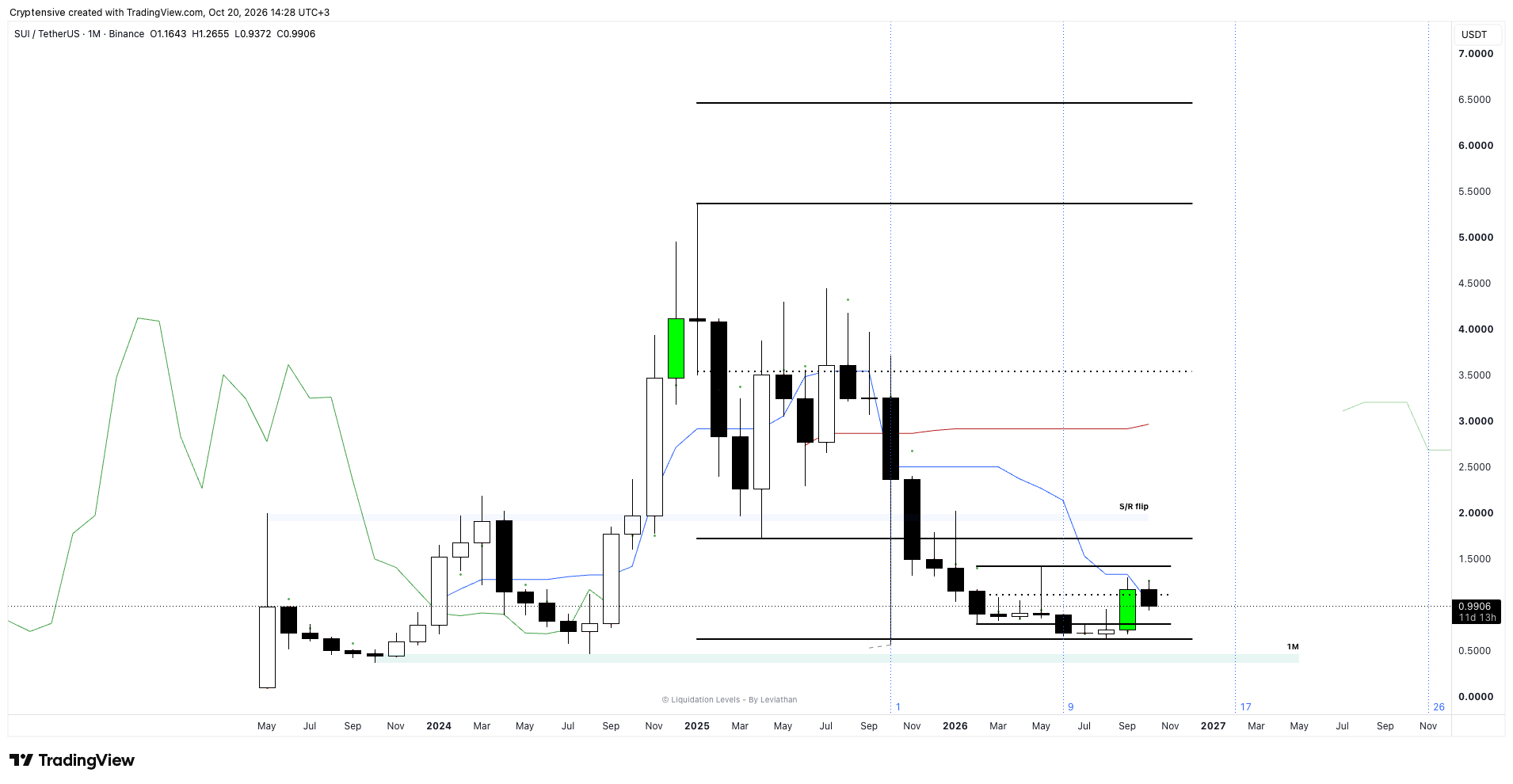
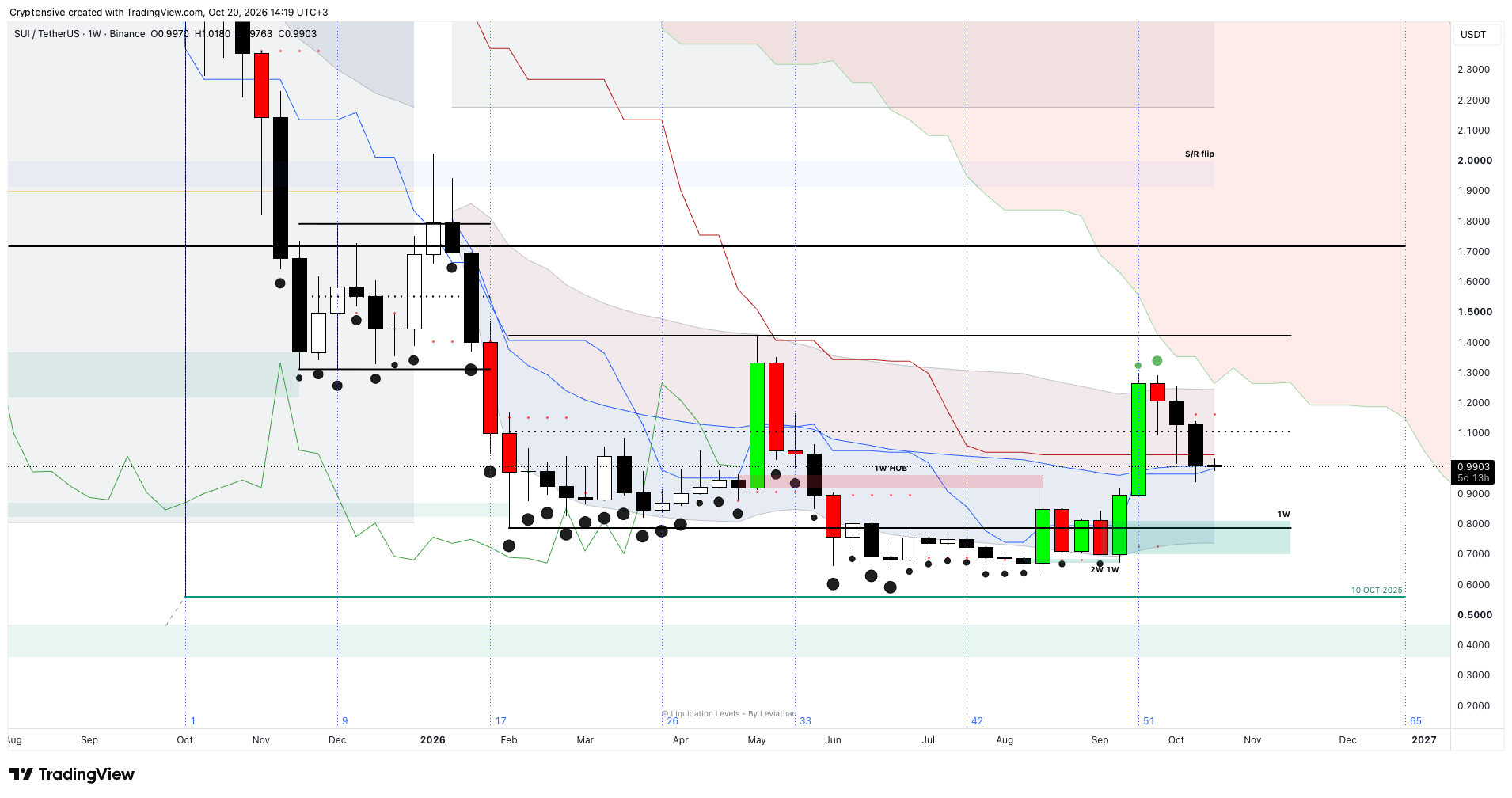
| Price (20 Oct 2026) | about $1.00 |
| All-time high | $5.35 (January 2025) |
| Market cap | about $4 billion |
The supply was split roughly as follows: 50% for a community reserve, 20% for early contributors, 14% for investors, 10% for the Mysten Labs treasury and 6% for early community sales and testers. Most of what is still locked is released in monthly unlocks that continue for years. Each one is small, but together they add steady selling pressure, and they are one reason the price has struggled.
2026: ETFs, payments and Bitcoin
Sui has had a busy year on the business side:
- ETFs. On 18 February 2026 the first US spot SUI ETFs started trading: Canary Capital’s fund on Nasdaq (ticker SUIS) and Grayscale’s fund on NYSE Arca (GSUI). Both pass on staking rewards. 21Shares followed with its own spot fund days later. For traditional investors, this means exposure to SUI through a normal brokerage account.
- Payments. After stablecoin transfers became free in May, stablecoin volume on Sui jumped, with the network reporting $65 billion in stablecoin volume by mid-June.
- Bitcoin. In March 2026, Hashi, a protocol for using Bitcoin as collateral on Sui, launched with backing from BitGo and FalconX.
Security and reliability
This is where Sui’s record is weakest.
Outages. Sui has stopped producing blocks three times since late 2024: for about two hours in November 2024, for almost six hours on 14 January 2026 (caused by a bug in how validators processed consensus, according to Sui’s post-mortem), and again on 28 May 2026. No user funds were lost, but a payments network that stops for hours is a serious problem, and each halt weighed on the price.
The Cetus hack. In May 2025, an attacker drained about $223 million from Cetus, Sui’s largest decentralized exchange, by exploiting a bug in its code. Sui validators quickly froze around $162 million of the stolen funds, and the community later voted to return them to victims. Users were glad to be repaid, but the episode showed that a group of validators can freeze funds on Sui — something critics see as a sign the network is more centralized than a blockchain like Ethereum.
DeFi activity. Money deposited in Sui’s DeFi apps peaked at about $2.6 billion in October 2025 and stood at roughly $480 million in October 2026, according to DeFiLlama. Much of that drop comes from the lower SUI price, but it also shows that Sui’s DeFi scene has lost momentum.
Sui vs. the competition
| Sui | Solana | Aptos | |
|---|---|---|---|
| Launched | 2023 | 2020 | 2022 |
| Language | Move | Rust | Move |
| Main strength | Parallel objects, easy onboarding | Biggest ecosystem and liquidity | Same Move roots, similar speed |
Solana remains far bigger in users, apps and money. Aptos, built by another team of former Diem engineers, is Sui’s closest technical twin. Sui’s edge is its focus on user experience, with free stablecoin payments, social logins and sponsored fees.
Our verdict
Sui is one of the most technically impressive blockchains launched in recent years, and in 2026 it has turned that into real products: free stablecoin payments, a Bitcoin finance protocol and regulated ETFs. If its vision of crypto apps that “just work” for ordinary users succeeds, Sui is well placed.
But the risks are real. Two network halts in one year, a frozen-funds episode that raised questions about decentralization, years of token unlocks still ahead and a price about 80% below its peak all mean that SUI is a high-risk, speculative investment. If you buy it, do so with money you can afford to lose, and consider keeping it in a wallet you control.
This review is for information only and is not financial advice.