Overview
Solana is a Layer 1 blockchain built for speed. It was created by Anatoly Yakovenko, a former Qualcomm engineer, who published the idea in 2017. The network went live in March 2020.
Where Ethereum spreads activity across many Layer 2 networks, Solana takes the opposite approach: one very fast chain where everything happens in the same place. That design has made it the home of fast trading, meme coins, payments and consumer apps, and turned SOL into one of the largest cryptocurrencies, worth around $60 billion.
Development is shared between several organizations: the Solana Foundation, the engineering firm Anza, and Jump Crypto, which builds a second, independent validator program called Firedancer.
How it works
Solana uses proof of stake, like Ethereum: validators lock up SOL to secure the network and earn rewards. Its special ingredient is Proof of History, a built-in clock that timestamps transactions, so validators can agree on their order very quickly.
Solana also runs transactions in parallel: transactions that don’t touch the same accounts can be processed at the same time instead of one by one. A new block arrives every 0.4 seconds, and a typical transaction costs well under a cent.
The trade-off is hardware. Solana validators need powerful, expensive machines and fast internet connections, which means fewer people can run one than on Ethereum.
Upgrades: Alpenglow and Firedancer
Two big projects are changing how Solana works:
- Alpenglow replaces Solana’s original consensus system. Its goal is to cut the time it takes for a transaction to become final and irreversible from about 12.8 seconds to around 150 milliseconds — faster than the blink of an eye. It is scheduled to activate on mainnet on 21 October 2026. The speed target is a design goal that still has to prove itself under real conditions.
- Firedancer is a second validator program, written from scratch by Jump Crypto. Having more than one program means a bug in one of them can’t take the whole network down, which was a cause of several past outages. Firedancer-based clients already run a meaningful share of the network (around 16% of stake among top validators in October 2026).
The SOL token
| SOL at a glance | |
|---|---|
| Supply (Oct 2026) | about 636 million SOL (590 million circulating) |
| Maximum supply | none (no fixed cap) |
| Inflation | around 4% a year, falling to 1.5% over time |
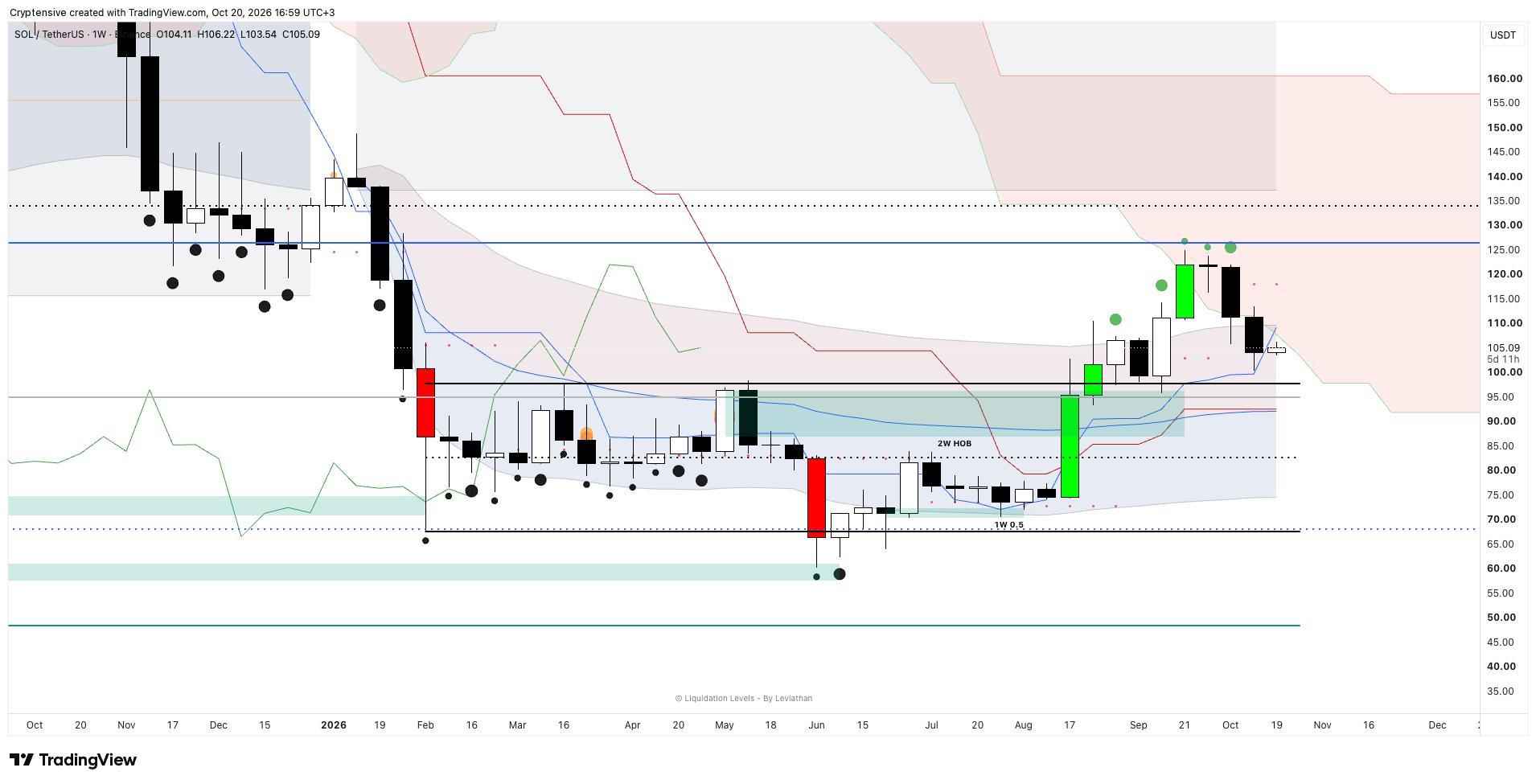
| Price (20 Oct 2026) | about $104 |
| All-time high | about $293 (January 2025) |
| Market cap | about $61 billion (#7) |
SOL is used to pay fees and to stake. New SOL is created as staking rewards, at a rate that started at 8% a year and drops by 15% each year until it settles at 1.5%. Part of every fee is burned. Most SOL is staked, earning roughly 6–7% a year, so holders who stake keep up with inflation, while those who don’t are slowly diluted.
ETFs, stablecoins and companies
Solana has become the third crypto network, after Bitcoin and Ethereum, to attract serious Wall Street interest:
- ETFs. US spot Solana ETFs launched in late 2025, and most of them stake their SOL and pass on the rewards. They have attracted about $1.56 billion in net inflows in total. Sentiment cooled in October 2026, with about $57 million of outflows over eleven straight trading days.
- Stablecoins and payments. About $15 billion in stablecoins now sits on Solana, the second most after Ethereum. Visa and Stripe both use Solana for stablecoin payments.
- Tokenized stocks. Platforms like Ondo bring tokenized shares of US companies to Solana.
- Treasury companies. In 2025 several listed companies built SOL reserves, led by Forward Industries. Not all have stayed: in October 2026, SkyAI sold its entire SOL holding at a loss.
Activity keeps growing: Solana processed about 8.9 billion transactions in the third quarter of 2026, roughly double a year earlier.
Security and reliability
Solana’s biggest weakness has been outages. Between 2021 and early 2024, the network stopped producing blocks several times, once for about 17 hours in September 2021, and most recently for about five hours on 6 February 2024. Each one damaged trust.
Since then, the record has been strong: as of September 2026, the network had run for about 30 months without a halt. There have been close calls, though. On 12 August 2026, a problem at the hosting provider TeraSwitch knocked about 29% of staked SOL offline for around half an hour. The network kept running, but the incident showed how much of Solana depends on a few data centers.
Solana’s history also includes the FTX collapse in November 2022. FTX and its sister firm Alameda were major Solana backers, and SOL fell to about $8. The ecosystem’s recovery since then is one of crypto’s biggest comebacks.
Money deposited in Solana’s DeFi apps stood at about $5.9 billion in October 2026 according to DeFiLlama, down from a peak of $13.2 billion in September 2025, mostly because of the lower SOL price.
Solana vs. the competition
| Solana | Ethereum | Sui | |
|---|---|---|---|
| Launched | 2020 | 2015 | 2023 |
| Scaling approach | One fast chain | Layer 2 networks | One fast chain |
| Typical fee | Under $0.01 | Higher on mainnet, cents on Layer 2 | Under $0.01 |
| Halts | Several (2021–2024), none since | None | Three (2024–2026) |
| Main strength | Trading volume, users, speed | Security, DeFi, institutions | Easy onboarding, free stablecoin transfers |
Ethereum remains the leader in total value and institutional trust. Sui is a newer rival with similar goals. Solana sits in between: much faster and cheaper than Ethereum’s main network, and far larger and more battle-tested than newer chains.
Our verdict
Solana has become one of crypto’s most important networks. It is where much of the everyday trading happens, it handles billions of transactions every quarter, and it has gone more than two and a half years without an outage. Alpenglow and Firedancer could make it faster and sturdier still.
The risks are real, though. Much of its activity depends on meme-coin speculation, its network still relies on a small number of hosting providers, and SOL trades about 65% below its 2025 high. For investors who believe in a fast, single-chain future, SOL is one of the leading bets, but it is a volatile, high-risk asset. Invest only what you can afford to lose, and consider keeping your SOL in a wallet you control.
This review is for information only and is not financial advice.