Overview
Celestia is a blockchain with one specific job: data availability. It launched in October 2023, founded by Mustafa Al-Bassam and others, with a large airdrop of its TIA token.
Traditional blockchains do everything themselves: run transactions, agree on their order and store the data. Celestia popularized the modular approach, splitting these jobs up. Rollups and other chains run their own transactions and use Celestia only to publish their data cheaply and safely, so anyone can check it.
How it works
Chains send their data to Celestia in packages called blobs. Celestia orders them and guarantees the data was published, but doesn’t execute it.
Its key innovation is data availability sampling: instead of downloading every block in full, light nodes, even on a phone, download a few random pieces. If all pieces are available, the whole block very likely is. This lets Celestia grow its capacity without making each node heavier.
The Fibre upgrade
In October 2026, Celestia activated Fibre, a new high-throughput lane that lets rollups upload large amounts of data directly to validators. Each Fibre blob can be up to 128 MB. In a controlled test, the system handled a record 3 terabits per second of data. Fibre is designed for future demand from high-volume apps, such as on-chain trading and games.
The challenge is that current demand is far smaller. On some days in September 2026, the whole network earned only around $70 in fees, a sign that Celestia has much more capacity than users today.
The TIA token
| TIA at a glance | |
|---|---|
| Total supply | about 1.18 billion TIA (growing) |
| In circulation (Oct 2026) | about 984 million |
| Inflation | about 2.5% a year, falling to 1.5% |
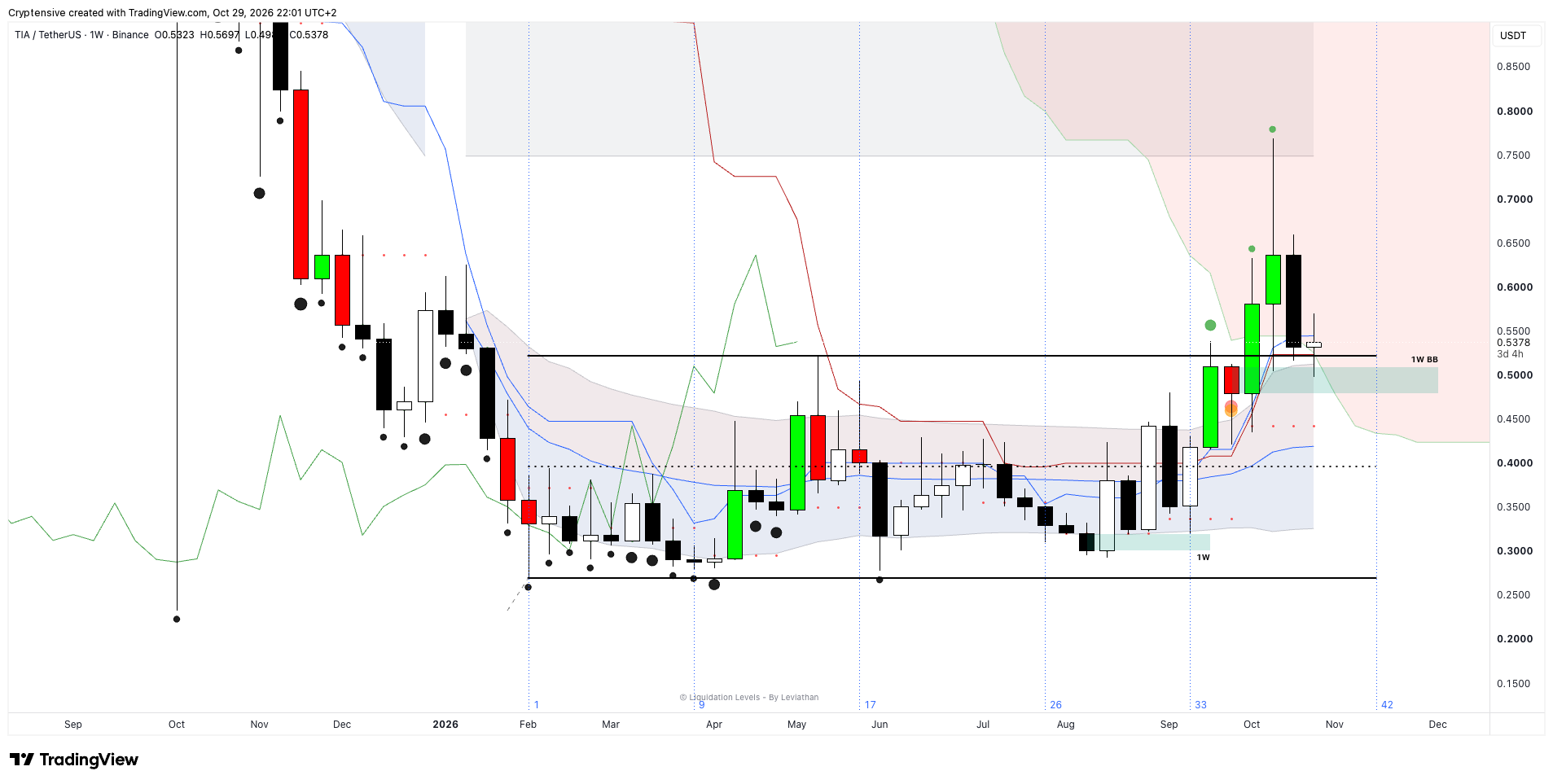
| Price (21 Oct 2026) | about $0.63 |
| All-time high | about $20.85 (February 2024) |
| Market cap | about $620 million (#102) |
TIA is used to pay for blob space, staked to secure the network and used in governance. Inflation was cut to about 2.5% in November 2025 and keeps falling each year until it reaches 1.5%.
Because fees are so small, almost all staking rewards come from new TIA rather than real usage. A “Sustainable Blob Economy” proposal, revised in September 2026, explores paid capacity commitments and using protocol revenue to partly replace inflation, but it has not been adopted yet.
Security and reliability
Celestia’s network has run reliably since launch, with no major hacks. The main risks are economic:
- Competition from Ethereum. Ethereum’s 2024 and 2025 upgrades (Dencun and Fusaka) added cheap “blob” space of its own, so many rollups no longer need an outside data layer.
- Other data layers. EigenDA and Avail compete for the same customers.
- Demand gap. Much of TIA’s value depends on future demand that hasn’t arrived yet.
Celestia vs. the competition
| Celestia | Ethereum blobs | EigenDA | |
|---|---|---|---|
| Type | Separate data blockchain | Built into Ethereum | Data service secured by restaked ETH |
| Security | TIA stakers | Ethereum validators | Restaked ETH |
| Cost | Very low | Low | Very low |
| Data sampling | Yes, even by light nodes | Partly, by full nodes (since Fusaka) | No |
Our verdict
Celestia changed how the industry thinks about blockchains: the modular idea it championed is now everywhere, and Fibre gives it enormous capacity for the future.
But technology isn’t the same as demand. Fees are tiny, Ethereum now offers cheap data itself, and TIA has lost about 97% of its value since early 2024, despite recent gains. TIA is a high-risk bet that data-hungry apps will eventually fill Celestia’s space. Invest only what you can afford to lose.
This review is for information only and is not financial advice.