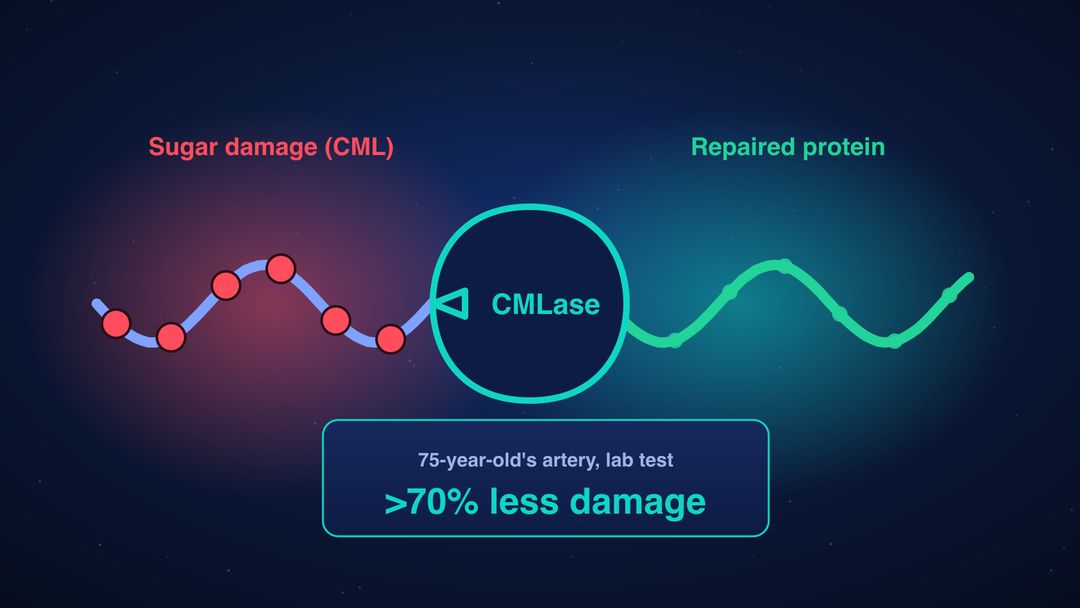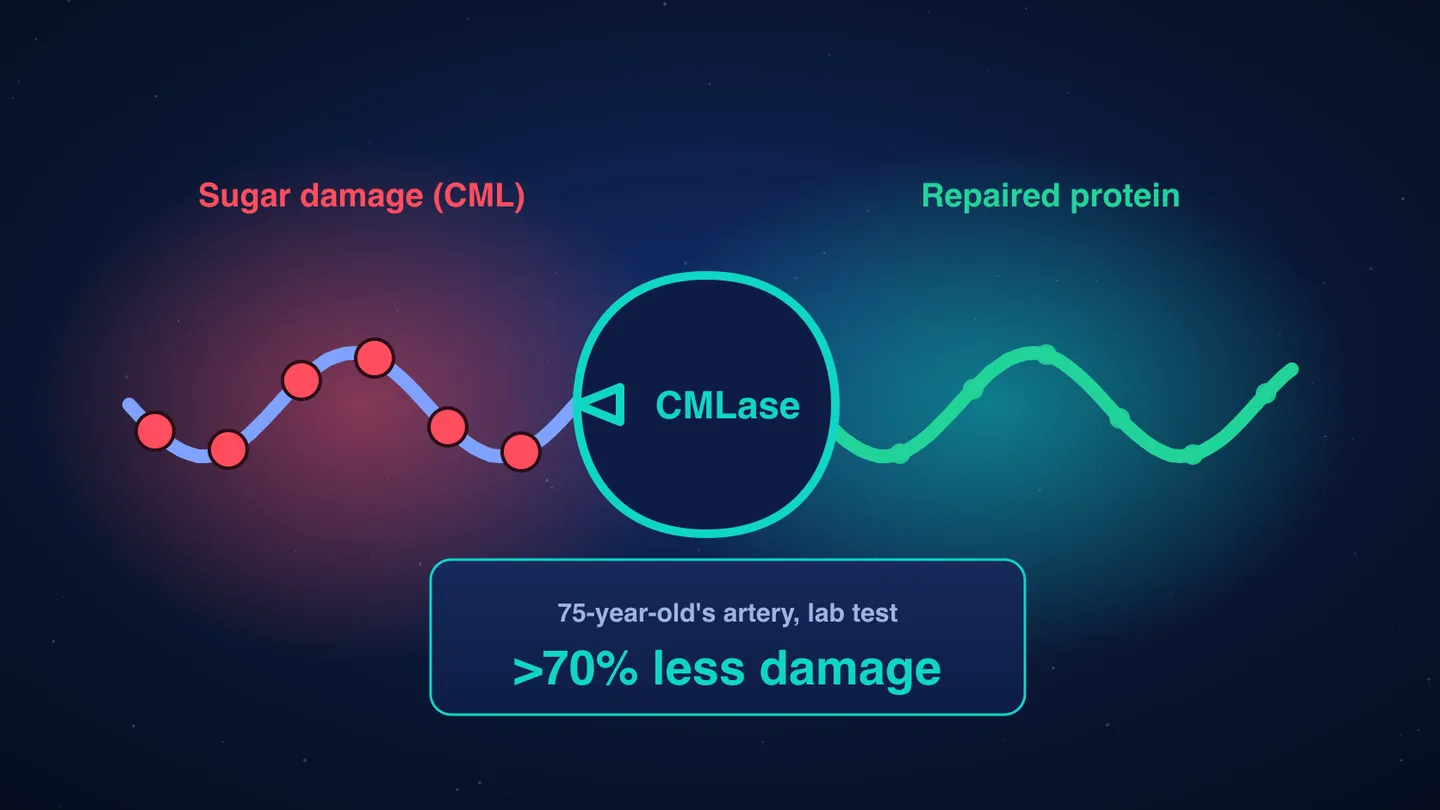
Revel Pharmaceuticals, a private enzyme-engineering company from San Francisco, has built an enzyme called CMLase that repairs a type of protein damage which builds up as we age and was long seen as irreversible. In lab tests on tissue from older human donors, it removed more than 70% of the damage from artery tissue and more than 55% from skin. The results were published in the peer-reviewed journal Nature Communications on July 14, 2026. It is early research: the enzyme has not been tested in people.
Key facts
- The damage: when sugars react with proteins, they leave chemical marks called advanced glycation end products (AGEs). One of the most common is CML (Nε-carboxymethyl-lysine). It piles up for decades in long-lived proteins such as collagen in skin and arteries and the proteins of the eye lens, and it is linked to chronic inflammation, diabetes complications and age-related disease.
- What the enzyme does: CMLase removes the CML mark and gives back the original, healthy building block (the amino acid lysine) underneath. It repairs the protein instead of destroying it. Revel says no enzyme in nature is known to do this.
- How it was made: the team started from an enzyme of a heat-loving bacterium and used directed evolution, a lab version of natural selection, testing more than 500 million variants to find one that attacks CML but leaves healthy protein alone.
- Results in human tissue (donated samples, treated in the lab):
- Artery from a 75-year-old donor: CML down more than 70%.
- Aged skin: CML down more than 55%, to below the level seen in the skin of a 31-year-old.
- Eye lens: CML down 78% by one test (ELISA) and 45% by a more complete measurement (mass spectrometry), likely because the enzyme reaches surface damage more easily than damage buried inside proteins.
- Who did it: 8 researchers from Revel Pharmaceuticals, Calico Life Sciences (the Alphabet-backed company that studies aging) and the University of Colorado Anschutz Medical Campus. Revel’s CEO, Aaron Cravens, led the work.
- Patent: Revel has filed a US patent application on the enzyme.
What it does not show yet
- No treatment exists. The tests were done on thin slices of tissue in the lab, where the enzyme can reach the damage easily. Nobody knows yet if it can get into living tissue in the body.
- No date for human trials. Revel says it is working toward its first human studies but has given no timeline. The enzyme is not sold in any clinic, supplement or skincare product.
- One kind of damage only. CMLase does not touch glucosepane, the most common sugar “crosslink” that stiffens human tissue. Revel itself says removing CML alone will not reverse aging.
Cravens said the team was expecting about a 20% reduction and was “pretty floored” by the result. He also explained why the company tests on human tissue instead of mice: the tissues of a 50- to 70-year-old person carry a very different load of damage than those of a 2-year-old mouse.
Why it matters
For almost 40 years, sugar damage to long-lived proteins was treated as a fixed, one-way part of aging. This study is the first proof that an engineered enzyme can undo one common type of it in real aged human tissue. Revel says the same method could be pointed at other kinds of damage, including glucosepane. For investors, Revel is not listed on any stock exchange, so there is no share to buy. The study is a sign of where longevity research is heading, not a product that is close to market.
This article is for information only and is not medical or financial advice.