
Overview
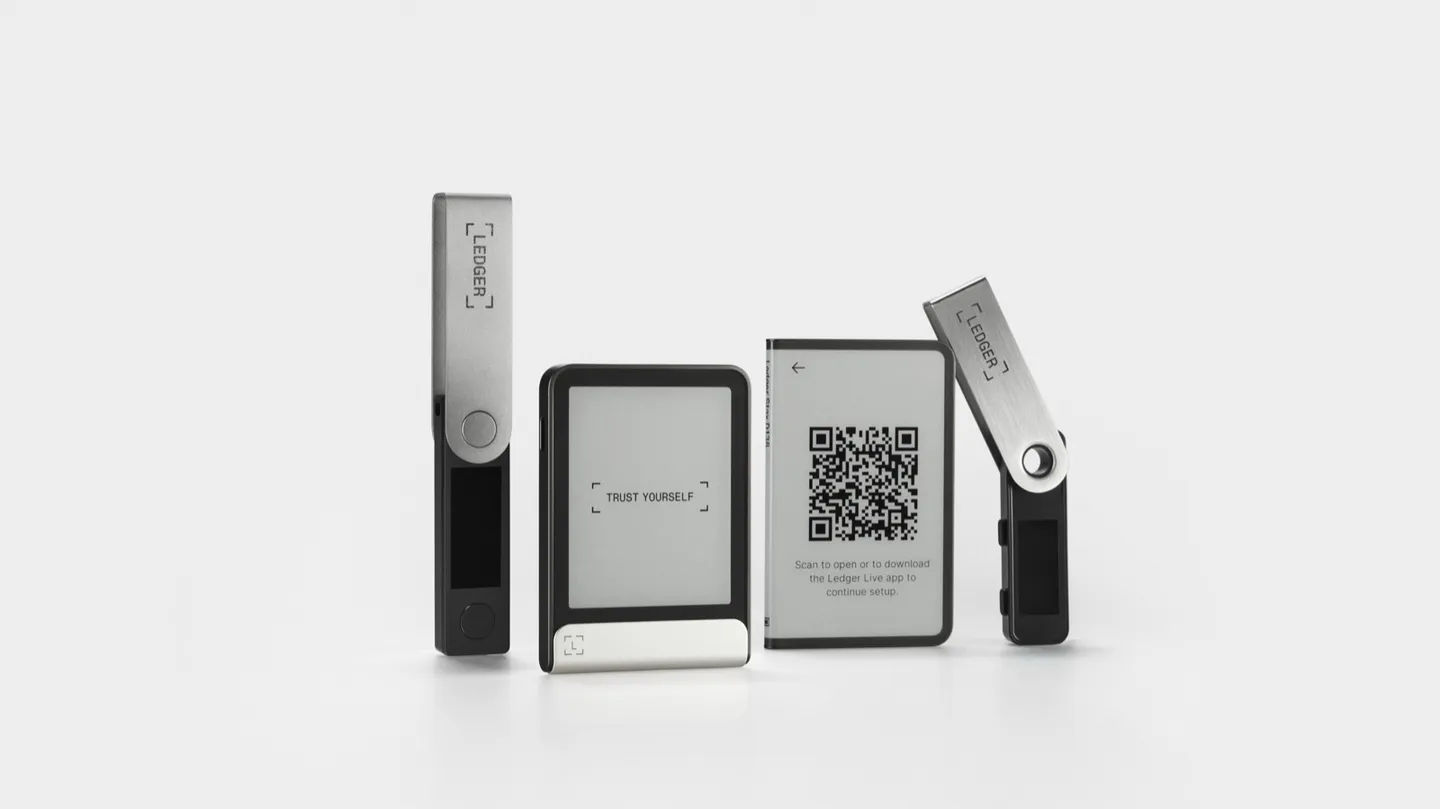
Ledger is the best-known name in hardware wallets. The French company was founded in 2014, and it says it has sold more than seven million devices. Its wallets keep your private keys offline, inside a tamper-resistant chip, so they stay safe even if your computer or phone is infected with malware — and even if the exchange you used to buy your crypto goes bust.
Ledger offers the widest range of devices on the market, from a simple USB stick for under $100 to premium touchscreen models, all managed with the same app: Ledger Wallet (called Ledger Live until 2025).
How it works
Every Ledger device contains a secure element — the same type of chip used in passports and bank cards, certified to a high security level (CC EAL5+ or EAL6+, depending on the model). Your private keys are created and stored inside this chip and never leave it.
Setting up takes about 15 minutes:
- Connect the device to the Ledger Wallet app on your computer or phone.
- Choose a PIN code — after three wrong attempts the device wipes itself.
- Write down your 24-word recovery phrase on the sheet in the box. This is the master backup of your wallet: anyone who has these words has your crypto, and if you lose your device, these words let you restore it. Never type them into a computer or phone, and never share them with anyone — Ledger will never ask for them.
To send crypto, you prepare the transaction in the app, then check the address and amount on the device’s own screen and confirm with its buttons or touchscreen. That screen is the key security feature: even if your computer is hacked and shows a fake address, the device shows you the real one.
The models and prices
Approximate official prices in autumn 2026:
| Model | Price | Screen | Connection |
|---|---|---|---|
| Nano S Plus | ~$79 | Small, monochrome | USB |
| Nano X | ~$149 | Small, monochrome | USB, Bluetooth |
| Nano Gen5 | ~$179 | 2.8” E Ink touchscreen | USB, Bluetooth, NFC |
| Flex | ~$249 | 2.8” E Ink touchscreen | USB, Bluetooth, NFC |
| Stax | ~$399 | 3.7” curved E Ink touchscreen | USB, Bluetooth, NFC, wireless charging |
Prices change and there are regular promotions, so check the official store.
In October 2026 Ledger also announced the Ledger Atom, a phone-sized Android “signer” with a large touchscreen, a privacy switch for the camera and microphone, and controls for AI agents. It costs about $899 (a limited Founder’s Edition is $849) and is expected to ship in summer 2027 — so it is not yet a product you can actually buy and test.
Which one to choose? The Nano S Plus is the best value if you use a computer and mostly hold for the long term. The Nano Gen5, launched in late 2025, is the new sweet spot: a large touchscreen and phone connectivity for a moderate price, which makes the older Nano X hard to recommend. The Flex and Stax add bigger, sharper screens and premium finishes — pleasant if you sign transactions often, but not more secure. The Gen5, Flex and Stax also come with a Ledger Recovery Key, an NFC card that stores an extra backup of your wallet.
The Ledger Wallet app
The free Ledger Wallet app runs on Windows, macOS, Linux, iOS and Android. It supports more than 15,000 coins and tokens, including Bitcoin, Ethereum and all EVM chains, Solana, XRP, Cardano, Polkadot and Tron. In the app you can:
- see your whole portfolio in one place;
- buy, sell and swap crypto through partner providers;
- stake coins such as Ethereum, Solana, Polkadot or Cosmos;
- manage NFTs on supported networks;
- connect to DeFi apps and use Ledger with wallets such as MetaMask or Rabby.
Ledger also promotes Clear Signing, which shows transactions in plain language on the device (“Swap 1 ETH for 3,000 USDC”) instead of unreadable code. As with Tangem, buying and swapping go through third-party partners, and their fees are often higher than on an exchange.
Security
Ledger’s hardware has a strong record: no one has remotely stolen funds from a properly used Ledger device. Its in-house security team, Donjon, actively tests its own products and those of competitors. But there are points every buyer should know:
- Closed-source firmware. The apps and Ledger Wallet are largely open source, but the secure-element firmware is not, due to the chip maker’s confidentiality rules. You have to trust Ledger and independent audits. Trezor, by contrast, is fully open source.
- The 2020 customer data leak. Hackers stole the names, addresses and phone numbers of about 270,000 customers from Ledger’s online shop. No crypto was stolen from devices, but victims were targeted by years of phishing emails, fake “replacement” devices and even threats. Never trust messages asking for your 24 words.
- Ledger Recover (2023). This optional paid service (about $10 per month) encrypts your recovery phrase, splits it into three pieces and stores them with three companies, with identity verification required to restore it. Many users were upset to learn that a firmware update could extract the phrase at all. Ledger points out that the service is strictly opt-in and you need to approve it on the device. If you don’t sign up, nothing leaves your device.
- Tampered devices from resellers (October 2026). A criminal group bought genuine Ledger devices, opened them, fitted a hidden chip that captured the 24-word phrase during setup and sent it over the mobile network, then put them back on sale through resellers in Southeast Asia. On-chain researchers estimate losses at over $86 million; Ledger says the total is not yet verified. Ledger stresses that its chip, software and servers were not hacked, and that it found no compromised units in its own stock. It halted sales in Southeast Asia and Hong Kong, and MediaMarkt paused Ledger sales in Europe after a report from Germany. The lesson: buy only directly from ledger.com, and treat any device that looks opened, or comes with recovery words already filled in, as compromised.
- The Connect Kit attack (December 2023). Hackers planted malicious code in a Ledger software library used by DeFi websites, draining around $500,000 from users who approved transactions during a few hours. The devices themselves were not hacked, but it showed why you should always read what you are signing.
Pros and cons
Pros
- Certified secure chip and a screen to verify every transaction.
- The widest coin support of any hardware wallet (15,000+).
- One polished app for desktop and mobile, with staking, swaps and DeFi.
- A model for every budget, from ~$79 to ~$399.
- Works with popular wallets like MetaMask and Rabby.
Cons
- Closed-source firmware.
- Past data leak, ongoing phishing, and the 2026 tampered-device attack via resellers.
- Ledger Recover showed that the phrase can be exported by firmware, which worries purists.
- You have to manage and protect a 24-word recovery phrase.
- Premium models are expensive compared with rivals.
Ledger vs. the competition
| Ledger Nano S Plus / Gen5 | Trezor Safe 3 / Safe 5 | Tangem (3 cards) | |
|---|---|---|---|
| Price | ~$79 / ~$179 | ~$80 / ~$170 | ~$70 |
| Screen | Yes | Yes | No |
| Supported assets | 15,000+ | Thousands (fewer than Ledger) | Thousands |
| Open-source firmware | No | Yes | No |
| Seed phrase | Required (24 words) | Required | Optional |
| Mobile use | Gen5: Bluetooth/NFC | Android only (USB) | Phone via NFC |
Trezor is the main rival: similar prices, fully open-source code and a strong reputation, but fewer supported coins and weaker mobile support. Tangem is cheaper and simpler, with no seed phrase and no cables, but it has no screen to confirm transactions. Other options, such as Keystone (QR codes, no cables) or BitBox02 (open source, minimalist), appeal to more specialised users.
Who it’s for
Ledger suits most people who hold crypto beyond a few hundred dollars — especially if you own many different coins, use DeFi, or want to manage your portfolio from your phone. Beginners on a budget should start with the Nano S Plus; frequent users will enjoy the Nano Gen5 or Flex.
If fully open-source code is a priority for you, look at Trezor. If you find the 24-word phrase intimidating, Tangem may be easier.
Verdict
Ledger remains the most complete hardware wallet ecosystem: a certified secure chip, a screen for every transaction, a polished app and unmatched coin support. Its reputation took real hits from the 2020 data leak, the Recover controversy and the 2026 tampered-device scheme, but its chip and software themselves have held up well. Buy directly from ledger.com, guard your 24 words, ignore any message asking for them — and Ledger is one of the safest places to keep your crypto.